
Kansas Projected Versus Actual Release
A projected date answers when release is expected under the facts and credits in the current computation. An actual release record answers whether the custody agency completed the book-out or prison departure. Those are different facts. A future date may pass without community release because the date changed, another custodian took the person, or the public system has not yet updated.
KDOC calls its public field “Anticipated release date.” The agency does not promise a universal field named “Actual Release Date.” After the anticipated day, look for a status, supervision level, movement, date discharged, or another exact label. A record showing parole or postrelease supervision may confirm physical release while also showing that KDOC authority continues.
Scheduled is not actual. A Kansas anticipated release date is a changeable estimate. Confirm the later custody status and the originating agency’s release record.
A pretrial detainee often has no sentence-based release date. Bond, a court order, dismissal, transfer, or later sentence can end or alter that custody. A person serving a county jail sentence depends on the court’s judgment, jail-credit finding, and the county’s own calculation. State-prison credit rules should not be applied to a local sentence by assumption.
Kansas Calls It Anticipated Release Date
The official label matters. “Projected release date” is the phrase many people search, but KASPER uses “Anticipated release date.” KDOC warns that good-time and program-credit earnings or forfeitures can change it. Copying the label with the date keeps a future estimate from being mistaken for a completed release or a final sentence discharge.
The KDOC locating FAQ and field guide documents the anticipated release date and its limits.

The captured guidance ties the date to live credit information instead of presenting it as a fixed promise.
Several other dates can appear in a Kansas corrections record. Parole eligibility permits Board consideration in an applicable old-law case. Conditional release is tied to an adjusted maximum term. Maximum-sentence date marks a different endpoint. Date discharged indicates the end of the KDOC obligation shown in the record. Each label must remain attached to its value.
Note: A parole eligibility date, hearing month, or grant does not confirm that a Kansas prisoner has completed release processing.
Find a Kansas Projected Release Date
KASPER is the main statewide route for a person in KDOC custody. It also keeps many supervised and discharged records, which helps when the date has passed. Use a KDOC number when possible. A name search needs careful identity checks because conviction county is the case origin, not necessarily the person’s residence or release destination.
The KASPER search application provides name, identifier, birth, physical, conviction-county, and supervision-county fields.
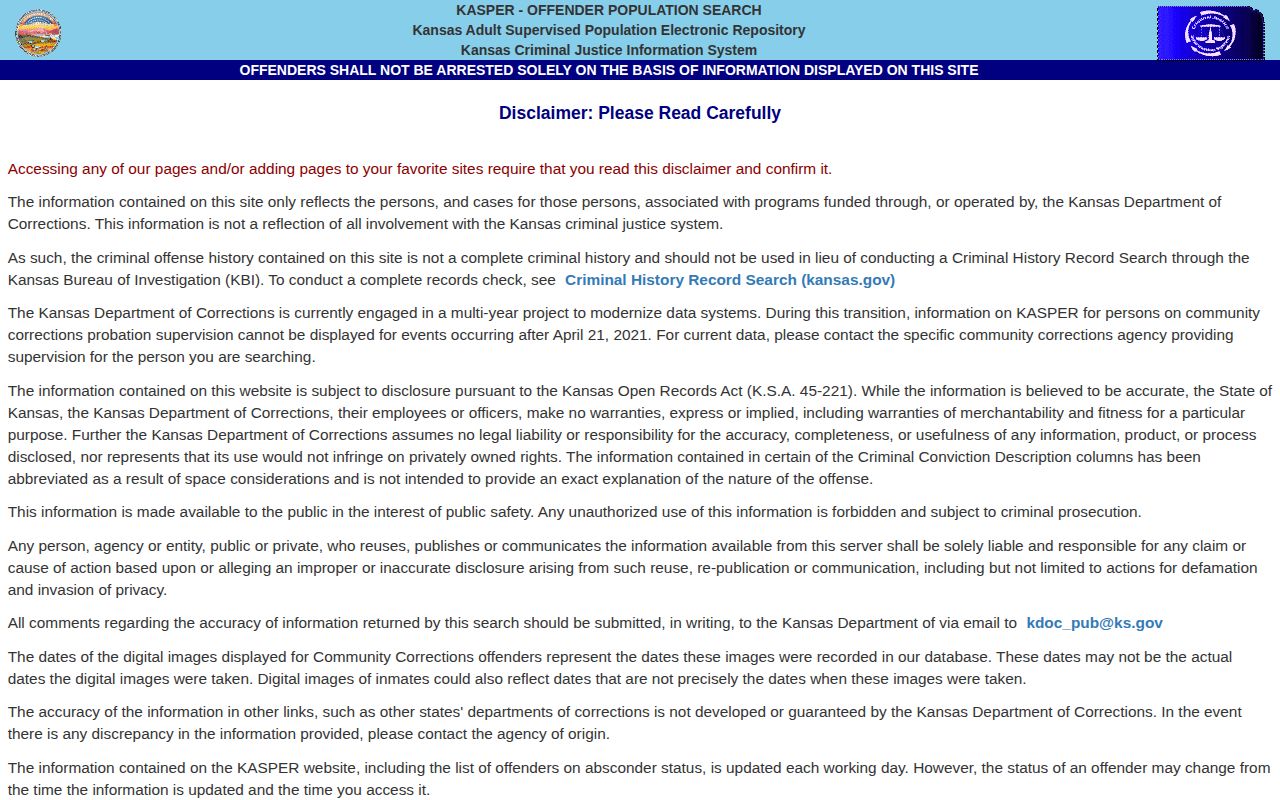
The advanced fields help confirm the correct person before an anticipated date is recorded.
- Identify whether the person is in KDOC state custody, a county jail, federal custody, or another system.
- For KDOC, accept the KASPER disclaimer and search by KDOC number. If it is unknown, use the full name and available advanced fields.
- Match the profile through the KDOC number, aliases, birth data, physical description, photograph, conviction county, case number, and offenses.
- Open the detail and locate “Anticipated release date.” Record the label, date, and date of access.
- Read current facility, movements, custody or supervision level, sentence dates, and parole-office information with it.
- For a county sentence, use the judgment and jail-credit finding, then ask the responsible county for the actual computation or release record.
- After the anticipated date, check again for status or movement and obtain the release record if documentary certainty is needed.
The full KDOC Offender Search workflow explains identity matching, released and discharged status, and the state records-request route.
Kansas Release Date Update Limits
KASPER says it updates each working day. KDOC’s FAQ describes updates as daily excluding weekends. Both statements warn against expecting a live operational feed. A Friday-night event, weekend transfer, forfeiture, or correction may not be visible at once.
The KASPER disclaimer sets out the working-day update cycle and the limits of the public data.
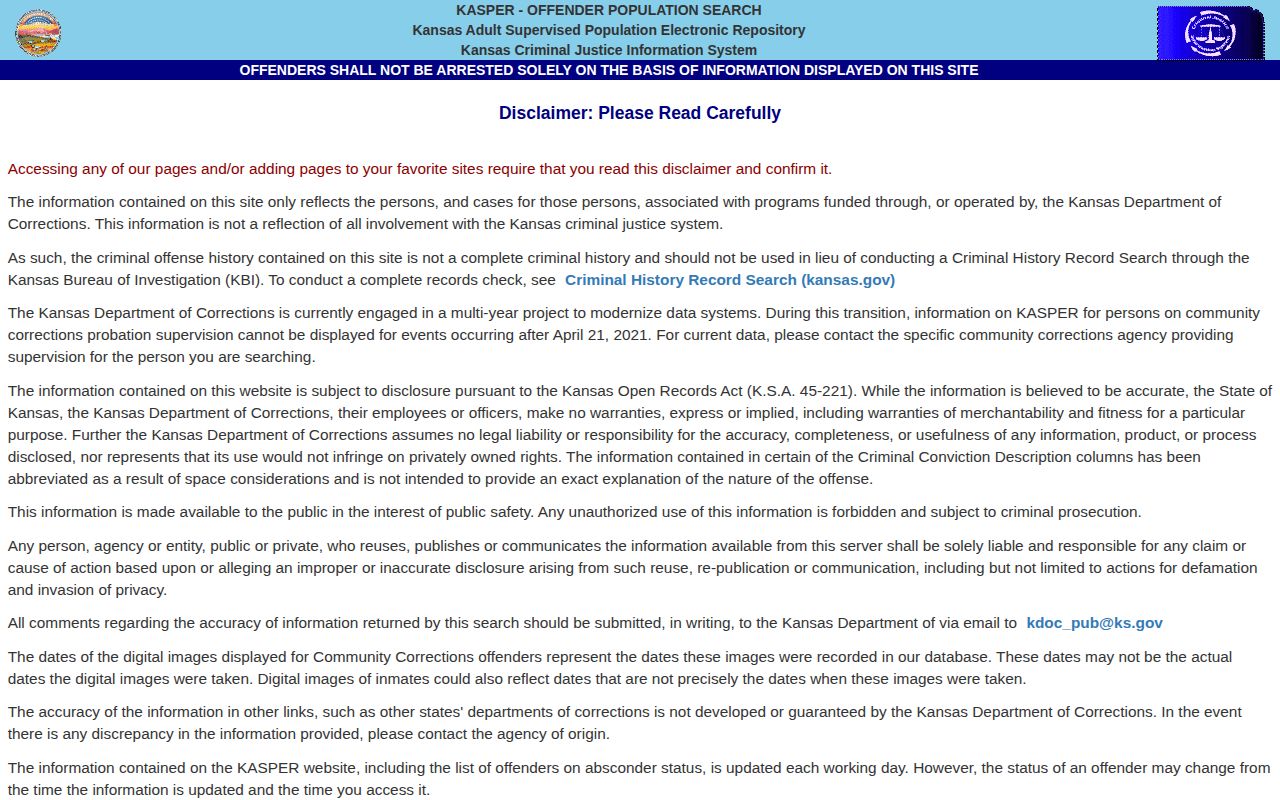
The entry screen is a reminder to verify a date with a later status or agency record before treating it as completed.
A missing record also has several possible causes. Spelling may differ, the event may belong only to a county jail, or an interstate-compact prisoner sent to Kansas may fall outside KASPER. KDOC says names can also be removed after an overturned or expunged conviction or executive clemency. None of these possibilities proves a person is currently free.
Kansas Guidelines Good-Time Credit
K.S.A. 21-6821 governs good time for many sentencing-guidelines cases involving crimes committed after July 1, 1993. The maximum deduction from the prison portion is generally 15 percent. Specified lower-severity nondrug crimes committed on or after January 1, 2008, and specified drug severity and date categories can have a 20 percent maximum.
Credits are not automatic days erased from every sentence. The statute ties good time to conduct and participation in assigned programs or work. Credit may be lost or not awarded. It also provides program credits for defined eligible groups. Sentence date, crime type, severity, exclusions, credit status, and other provisions decide which ceiling and rules apply.
| Sentence category | Release-date effect | Key limit |
|---|---|---|
| Many post-July 1, 1993 guidelines cases | Good time may reduce the prison portion | Generally up to 15 percent under K.S.A. 21-6821 |
| Specified later lower-severity or drug categories | A larger statutory ceiling may apply | Up to 20 percent only when the listed date and category rules fit |
| Eligible program-credit cases | Defined program credits may affect the computation | Eligibility and statutory exclusions control |
| Discipline or nonparticipation | Credit may be forfeited or not awarded | The displayed date can move later |
The common claim that every Kansas prisoner serves exactly 85 percent is too broad. Fifteen percent is a ceiling in many cases, not a promise of the full award. Other cases can use a different percentage or a different legal framework.
Older Kansas Release Date Rules
Crimes before July 1, 1993 require an older framework. K.S.A. 22-3725 addresses credit calculations tied to parole and conditional release for those cases. K.S.A. 22-3717 supplies detailed eligibility and postrelease rules, including special life, off-grid, and offense-specific terms.
An indeterminate sentence has a minimum and maximum. Parole eligibility is the point when the Prisoner Review Board may consider suitability. It is not a release order. Parole is discretionary. Conditional release, by contrast, is linked to the maximum term reduced by retained credits under the applicable law. Written conditions can continue until maximum expiration or discharge.
Guidelines sentences are generally determinate. The prison portion and mandatory postrelease supervision are computed under statute. KDOC explains that credited time is added to postrelease supervision in the applicable framework. Good time therefore does not always erase the rest of the state’s authority. It can shift time from prison into the community-supervision part.
- Determinate sentence
- A set prison portion followed by the supervision required under the guidelines framework.
- Indeterminate sentence
- An older sentence with a minimum, maximum, and possible discretionary parole.
- Parole eligibility
- The date Board consideration may begin, not a promised exit date.
- Conditional release
- A statute-based release tied to the adjusted maximum term and continuing conditions.
The Prisoner Review Board process page explains how the old-law and guidelines systems differ.

The Board’s explanation helps distinguish eligibility, a suitability outcome, release conditions, and final discharge.
What Changes Kansas Release Dates
A KASPER date reflects the current inputs. Some factors change the computation itself. Others explain why the anticipated date does not equal community release. A receiving-custodian transfer, for example, can end KDOC confinement without placing the person at liberty.
| Factor | Possible effect | Verification source |
|---|---|---|
| Good-time award or forfeiture | Moves the anticipated date earlier or later within the governing limit | KASPER and KDOC computation record |
| Program credit | Changes eligible computations when earned under the statute | KDOC record and K.S.A. 21-6821 |
| Consecutive or concurrent terms | Changes how multiple sentences combine | Judgment and KDOC sentence data |
| Jail credit | Applies court-awarded prior custody credit | Sentencing order and court record |
| Sentence correction | Changes the lawful term or credit basis | Later court order and updated KASPER data |
| Old-law parole or conditional release | Adds eligibility, Board action, and retained-credit rules | PRB, statute, and KASPER |
| Detainer or transfer | Can send the person to another custodian instead of the community | Movement, release record, and receiving agency |
| Final discharge | Ends the state sentence after release and supervision requirements | KASPER status or discharge certificate |
Parole Board action applies mainly to eligible indeterminate cases. A “continue” delays a final decision. A “pass” denies parole for a stated period. A grant is a suitability decision that still precedes release processing. Guidelines cases usually move to mandatory postrelease supervision after the computed prison portion.
County Kansas Release Date Records
A Kansas county jail uses local booking, court, and sentence records. A pretrial detainee has no KDOC good-time date to calculate. The next event may be bond, dismissal, court-ordered release, transfer, or sentencing. A person serving a local sentence needs the judgment, court-awarded jail credit, and the county’s actual computation.
Ask the responsible sheriff or county records custodian for the existing booking and release sheet or jail-register entry. Useful fields include admission and release date and time, booking number, release authority or type, receiving agency when maintained and public, charges, and bond entry. KDOC does not operate county jails and does not hold every local release record.
Can the state good-time percentage estimate a county date? No. A state-prison statute should not be applied to a local jail sentence without authority in the county record. The sentencing order and local computation control.
Note: Leaving a county’s current roster can mean release or transfer, so obtain the book-out reason before drawing a conclusion.
Confirm a Kansas Inmate Release
Recheck KASPER after the anticipated date. Read status, supervision level, movements, and any discharge field together. If the person moves to parole, conditional release, or postrelease supervision, physical prison custody ended while the KDOC sentence remained active. Discharge is a later and separate endpoint.
For a document, submit a narrow request for an existing release or discharge entry, movement into supervision, sentence computation, or certificate. Include the full name, KDOC number, conviction county or case, and date range. Electronic copies and a cost estimate make the scope clear.
The KDOC GovQA request portal provides both a request entry and a status-check route.
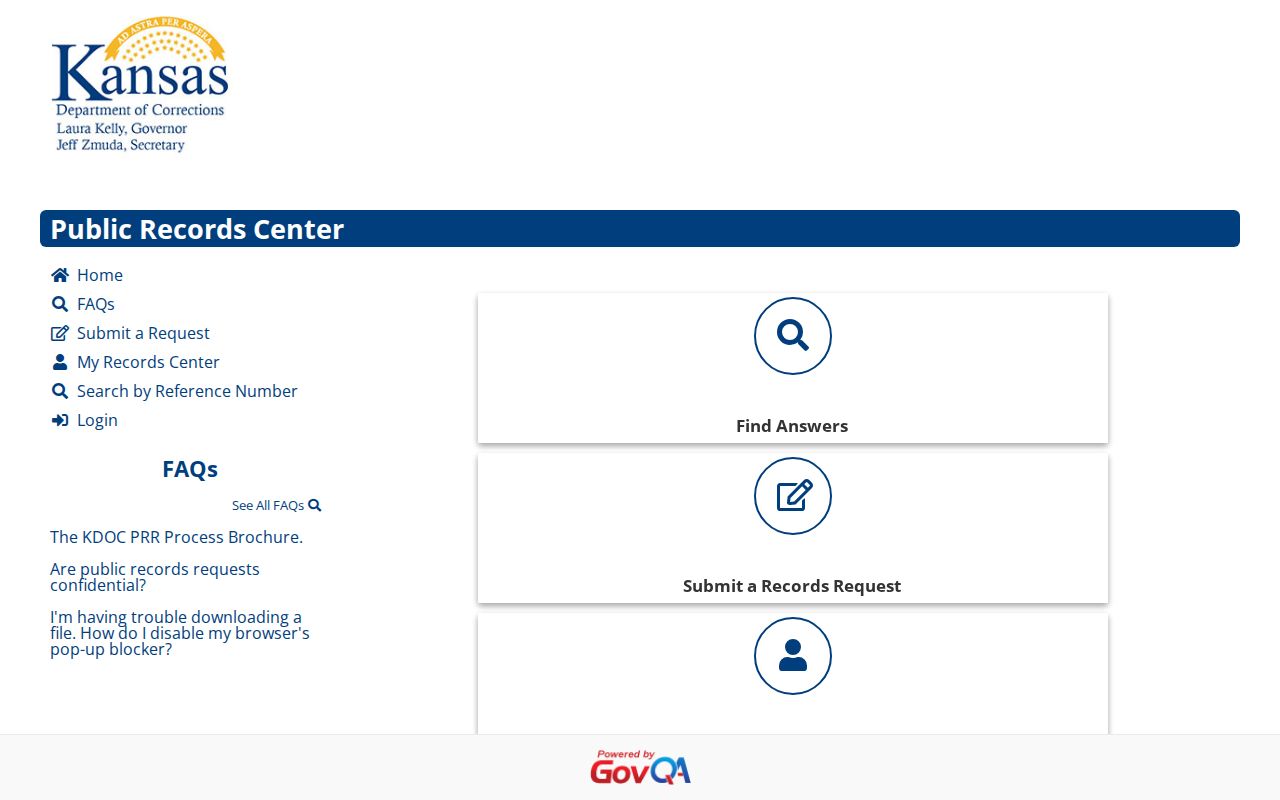
The records route is useful when a public date changed or the exact custody endpoint must be documented.
Kansas Open Records Act timing does not promise instant production. The custodian must act as soon as possible and by the end of the third business day, but a response can explain delay or cite a legal basis for denial. Fees based on authorized or actual costs may be required. Protected correctional content can be withheld while separable public information is released.
Keep the anticipated date with the KDOC number, exact label, and access date. If the value moves, that small record distinguishes a changed computation from a copying error. It also gives KDOC enough context to locate the relevant entry when a later status alone does not explain the change.
The sentencing court is the second check when a date changed because of a corrected judgment, jail-credit ruling, revocation, or later order. The statewide court portal can show case events, but online document depth begins with each court’s eCourt conversion. Some older documents are available only through courthouse terminals. A court order may authorize release while another hold or transfer still affects the actual custody endpoint, so use the court record to explain the legal basis and the custody record to confirm what happened.