
Kansas Prisoner Review Board Role
The Kansas Prisoner Review Board is the statewide body within KDOC that handles parole suitability for the cases subject to discretionary parole. It also addresses conditions, revocation, discharge, and clemency recommendations within its legal role. Kansas has two broad sentence systems. Older indeterminate cases use minimum and maximum terms, parole eligibility, and a Board suitability decision. Most sentencing-guidelines cases are determinate and move from a computed prison term to mandatory postrelease supervision rather than a discretionary parole grant.
Eligibility permits consideration. It does not show that the Board found the person suitable, that a release plan cleared review, or that the person left the institution. A parole grant still comes before release processing. For that reason, the schedule, Board outcome, KASPER status, movement history, and any written order answer separate parts of the same question.
The official PRB hub and process defines the Board's work and its main outcomes.
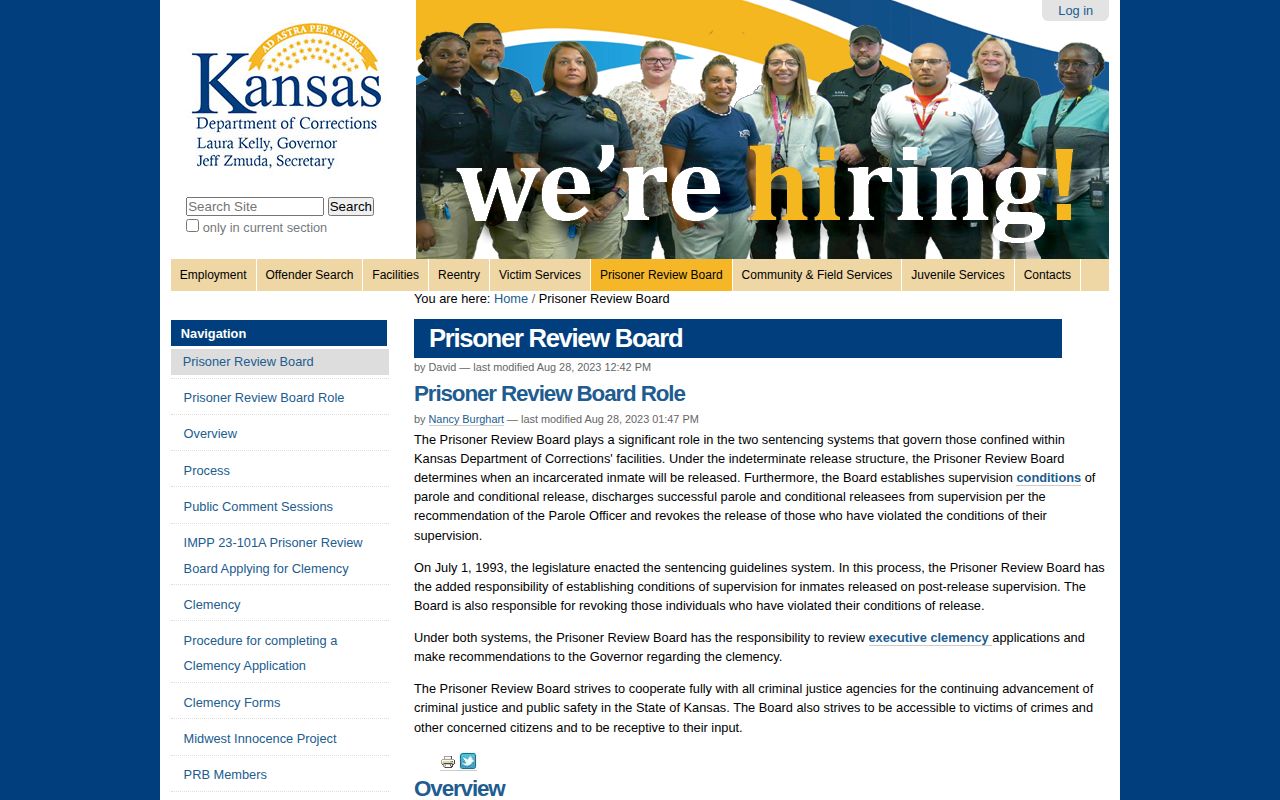
The hub is the best starting point for Board terminology, while the monthly pages carry the prospective schedule.
- Eligibility
- The point when governing law allows parole consideration. It is not a release decision.
- Suitability
- The Board's judgment on whether parole should be granted under conditions in an eligible case.
- Public-comment session
- A scheduled chance for input before the later parole hearing; it is not the hearing outcome.
- Postrelease supervision
- A supervision term that follows the prison portion of many determinate Kansas sentences.
Search Kansas Parole Hearing Schedule
PRB publishes public-comment sessions on a monthly cycle. A posting can connect three different months: the month of public comment, the following month of the parole hearing, and a later possible eligibility or release month. Read each label. A July 13, 2026 posting, for example, concerned a July 21 comment session, August hearings, and possible September eligibility. That example shows why the posting month cannot simply be copied as the hearing date.
The PRB public-comment calendar supplies the current dated schedule and the link to listed people.
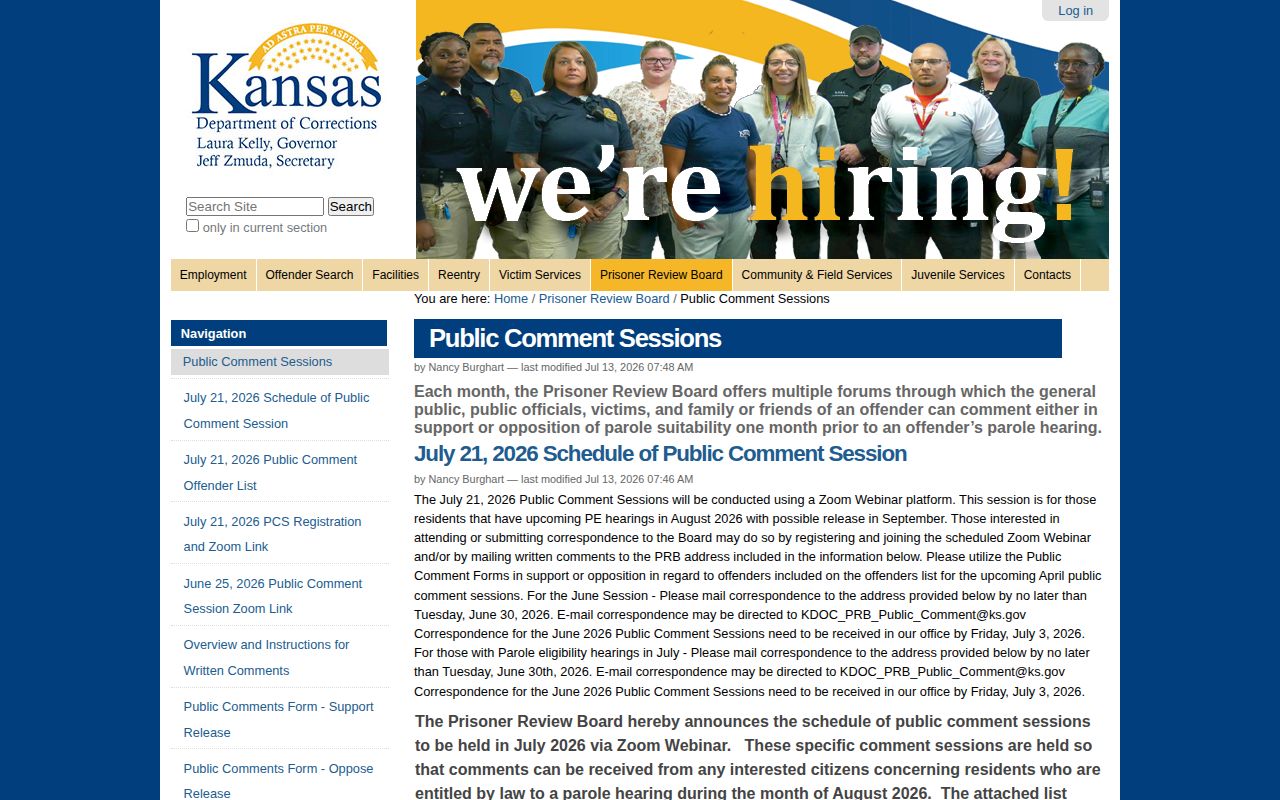
The page can change as PRB replaces or updates monthly material, so record the posting date and retrieve the live file again before relying on it.
- Open the current public-comment calendar and identify the posting date.
- Separate the comment-session month, parole-hearing month, and possible later eligibility month.
- Open the listed-people file linked for that cycle.
- Match the commitment name and KDOC number, then compare county, case, and offense details.
- Save the source date because the calendar and attachment roll forward each month.
Note: A schedule entry forecasts Board activity; it does not establish a final decision or an actual prison release.
Kansas Parole Listed People
The prospective list can include commitment name, KDOC number, conviction county, case information, and offense information. The KDOC number is the best key for joining the schedule entry to KASPER. Commitment name may differ from a name used now, so aliases and other identifiers still need review. County on the list means county of conviction. It does not prove where the person now lives, where the prison is located, or where a future release is planned.
The current PRB listed-people page shows the prospective person-level material.
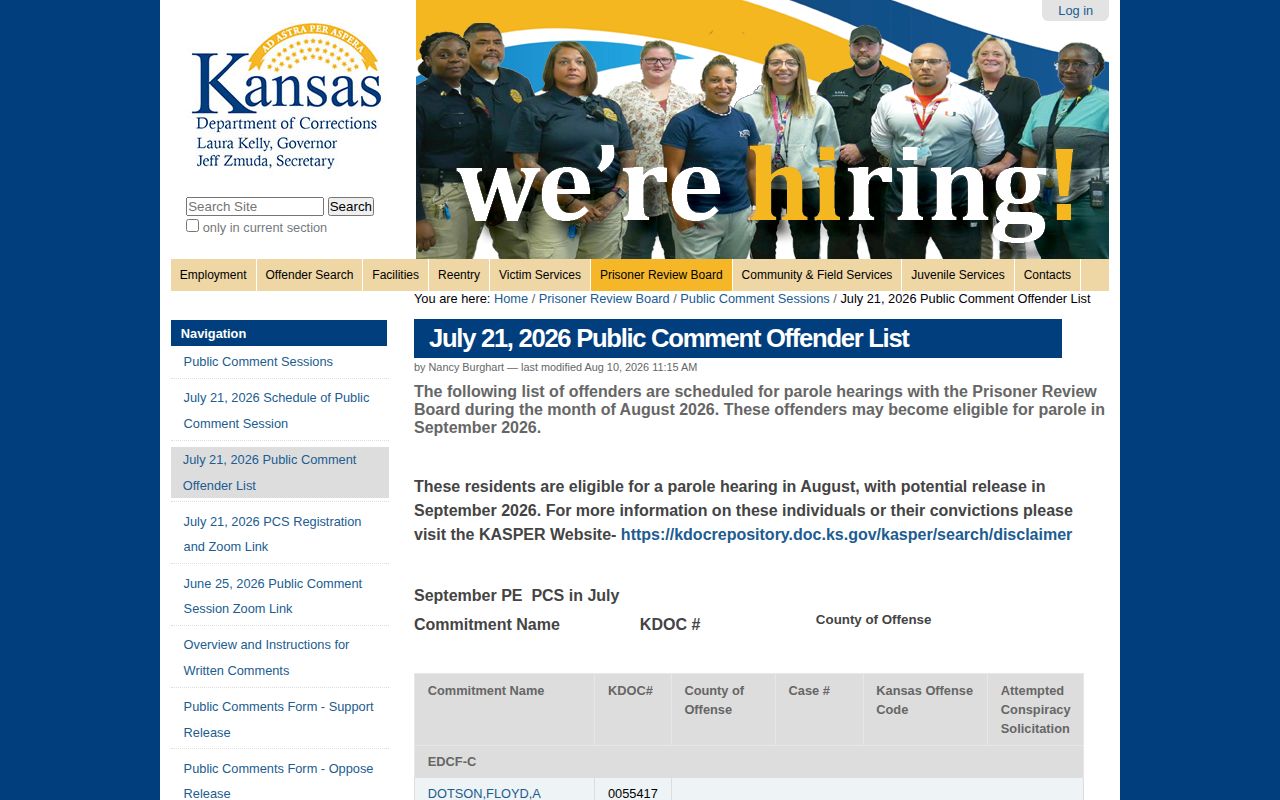
Use that list to identify the case, then use KASPER and any later Board record to track what followed.
| Listed item | What it establishes | What it does not establish |
|---|---|---|
| Commitment name | Name carried in the correctional matter | Identity without comparison to other fields |
| KDOC number | Direct correctional identifier | A grant or release |
| County and case | Origin of the conviction matter | Current residence or release destination |
| Offense information | Case context for the listed matter | Current custody status by itself |
| Schedule cycle | Expected timing of comment and review | A completed final outcome |
Kansas Parole Hearing Outcomes
PRB describes three basic outcomes: parole, continue, and pass. Exact wording should be preserved. Flattening them into approved, denied, and deferred can remove useful meaning. A parole outcome is a suitability decision to release under conditions, but operational processing remains. Continue means the Board needs more deliberation, information, votes, or evaluation before a final decision. Pass denies parole for a stated period.
| Outcome | Board meaning | Next verification |
|---|---|---|
| Parole | Suitability decision for conditional release | Check later KASPER status, movement, and supervision |
| Continue | Decision held for more review, material, votes, or evaluation | Follow the later Board cycle or written order |
| Pass | Parole denied for a stated period | Read the order for the period and next eligible review |
A grant does not equal a confirmed gate departure. KASPER may later move from an institutional status to parole, and it may name the supervising parole office. A transfer between KDOC facilities is not community release. If the exact outcome or its reasons are needed, obtain the releasable Board decision or order.
Conditional release is another distinct route. Under K.S.A. 22-3718, an eligible older sentence can reach a statute-driven release point after the maximum term is reduced by applicable retained credits. It carries written conditions until maximum expiration or another discharge. The statute also addresses advance notice before parole, conditional release, or expiration release into the community. A conditional-release date should not be relabeled as a discretionary parole grant.
No Kansas Decision Archive
No official public person-by-person final parole decisions search or stable historical results archive was verified. The listed-people page is prospective and must not be presented as a result page. This gap changes the workflow. A past name missing from the current monthly attachment may simply reflect the rolling calendar, not the lack of a hearing.
- Match the listed KDOC number to the KASPER person record.
- Record the hearing month shown in the dated PRB material.
- After the cycle, recheck KASPER for a status, movement, or supervision change.
- When a written outcome is needed, request the existing Board decision or order through KDOC.
The workflow keeps the absence of an online archive from becoming a false conclusion. It also distinguishes a public schedule from the underlying agency record.
Note: Current monthly attachments can replace older ones, so a missing name is not proof that no prior hearing occurred.
Request Kansas Parole Records
KDOC accepts electronic records requests through GovQA. Ask for an existing, narrow record rather than asking the agency to answer a broad question or create a report. Useful identifiers include full name, KDOC number, conviction county, case number, hearing month, and a clear date range. Name the desired item, such as the releasable PRB decision, order, or release-related entry. Request an electronic copy and a cost estimate.
The KDOC GovQA portal provides request entry and request-status tools.
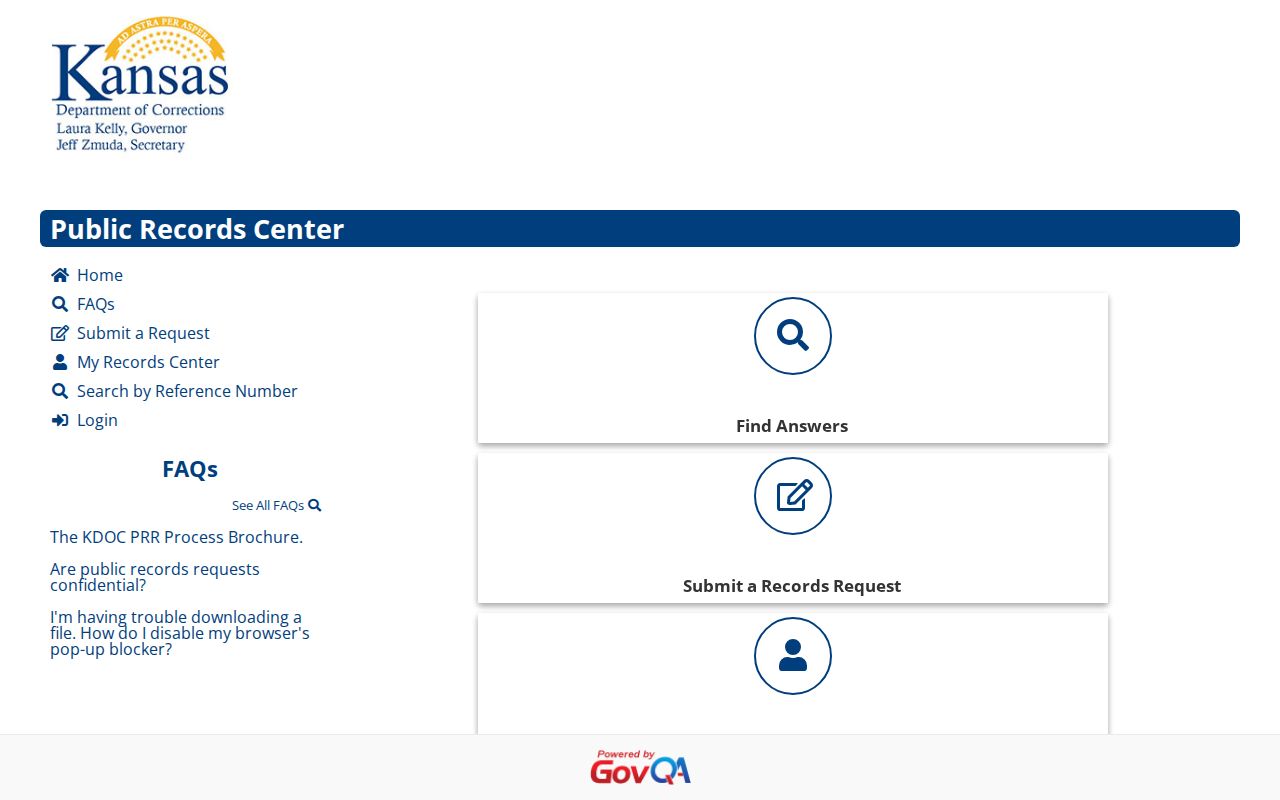
The portal is the documentary fallback when no public decision archive supplies the person-level result.
Kansas Open Records Act timing is often misunderstood. K.S.A. 45-218 requires agency action as soon as possible and by the end of the third business day. That is a response deadline, not a promise that production will be complete by then. Delay should state the reason and earliest availability. Authorized or actual costs and advance payment may apply. KDOC can withhold protected security, medical, investigation, or supervision-history material while releasing segregable public portions.
Kansas Parole Eligibility Rules
K.S.A. 22-3717 is the main parole-eligibility statute, but no single formula fits every Kansas sentence. The general indeterminate framework looks to the minimum sentence less applicable good time. Offense date, sentence type, special minimums, life or off-grid terms, and statutory exclusions can change the result. The date shown by KDOC should be copied with its exact label.
Sentencing-guidelines cases generally do not use a PRB suitability choice for the computed prison release. They move to mandatory postrelease supervision under the applicable framework. Older indeterminate cases are the main setting for discretionary parole. For individual certainty, compare the judgment, controlling statute, KASPER computation, and Board record. The Kansas post-release supervision record then explains the status that can follow an actual grant and release.
Good time also has different roles across these systems. In an older case, applicable credit can affect the point tied to parole or conditional release. In a guidelines case, earned credit can change the prison portion within statutory bounds while supervision still follows. A displayed anticipated release date, parole-eligibility date, conditional-release date, and maximum-sentence date are not interchangeable. Copy the agency's exact field name and trace it to the sentence that governs the person.
Kansas FY2024 Parole Figures
KDOC's FY2024 annual report offers statewide context without resolving any one person's case. It records 131 parole grants, 140 passes or denials, zero serve-to-mandatory-release decisions, and 14 continued or other decisions. Those labels should remain intact. The same report records 1,006 revocation packets, including 319 waivers and 687 hearings.
The report also lists 55 clemency applications, two functional-incapacitation applications, and 34 early-discharge requests, with seven approved. These are fiscal-year totals. They cannot be used to infer the decision for a named person, and the parole-grant count is not a completed-release count.
Always keep the fiscal-year label with these totals when citing them.
Kansas Clemency Starts at PRB
Kansas gives clemency a route that is distinct from a parole hearing. The state instructs an applicant not to send the application straight to the Governor. A complete application first goes to PRB. The Board reviews it, provides county-newspaper notice, asks specified officials for comment, and sends a recommendation. The Governor makes the final decision, and no set decision timeline applies.
The Governor's executive clemency instructions and the PRB clemency page should be read together. Clemency is not expungement. It is, however, one of the few reasons the KDOC locating FAQ says a name may be removed from KASPER, along with an overturned or expunged conviction.
A clemency application, PRB recommendation, and gubernatorial decision are separate records. The FY2024 application total does not reveal the outcome of a named application. Follow the official route and request the precise existing record when documentary proof is needed.
KDOC also says executive clemency can remove a name from KASPER. That makes a missing repository result a reason to inspect the clemency and court record, not proof that the person was never in KDOC custody. Because clemency, expungement, and ordinary parole have different legal effects, each event must keep its own name in any release timeline.