
KDOC Release Records in KASPER
KDOC means the Kansas Department of Corrections. Its public search is the Kansas Adult Supervised Population Electronic Repository, or KASPER. The system covers people sentenced to the Secretary of Corrections since 1980 who are incarcerated, under post-incarceration supervision, or discharged. That scope makes KASPER more useful for release research than a live prison roster. A person can remain searchable after leaving a prison gate because physical release and final sentence discharge are not the same event.
The KDOC locating FAQ says names normally remain unless a conviction is overturned, expunged, or executive clemency is granted. It also says interstate-compact prisoners sent to Kansas are excluded. KASPER is not a statewide collection of county bookings. Someone who posted bond or served a local jail term may have no KDOC entry at all.
The Kansas Department of Corrections home page identifies the agency behind this state-level record system.

The agency page is a starting point for KASPER, facilities, records requests, parole services, and Prisoner Review Board material.
Run a KDOC Offender Search
Begin at the official KASPER entry, not a copied profile. The disclaimer says data update each working day, may lag an operational change, and are not a complete criminal history. A Friday release, weekend return, transfer, or correction may happen before the public record changes. Save the date and exact field label seen during the search.
The KASPER disclaimer and search entry shows the limits a user must accept before searching.
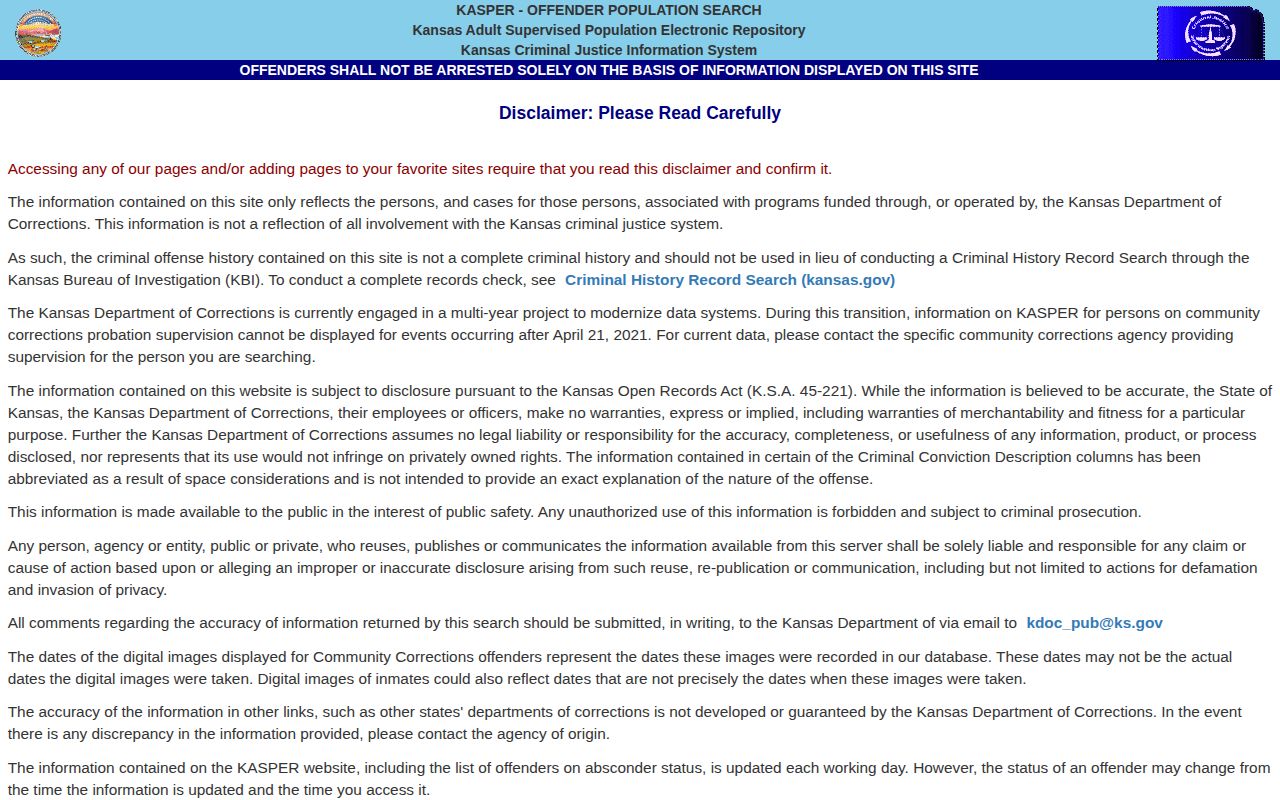
Those warnings matter when a public status trails a recent prison movement or release.
- Accept the KASPER disclaimer and open the application.
- Enter the KDOC number when known. Otherwise, use last, first, and middle name, then try the alias option if needed.
- Narrow a common name with the State ID or KBI number, race, gender, birth date, age range, conviction county, or parole-supervision county.
- Compare the KDOC number, aliases, birth details, photograph, physical description, conviction county, case number, and offenses before choosing a record.
- Read status, supervision level, sentence dates, movements, and parole-office location together. Do not treat a facility movement as release.
- Copy each date with its label. Anticipated release, parole eligibility, conditional release, date discharged, and maximum sentence describe different points.
- Request the existing release or discharge record when a public profile is not enough for the purpose at hand.
The KASPER application provides both direct identifiers and advanced fields for close identity checks.
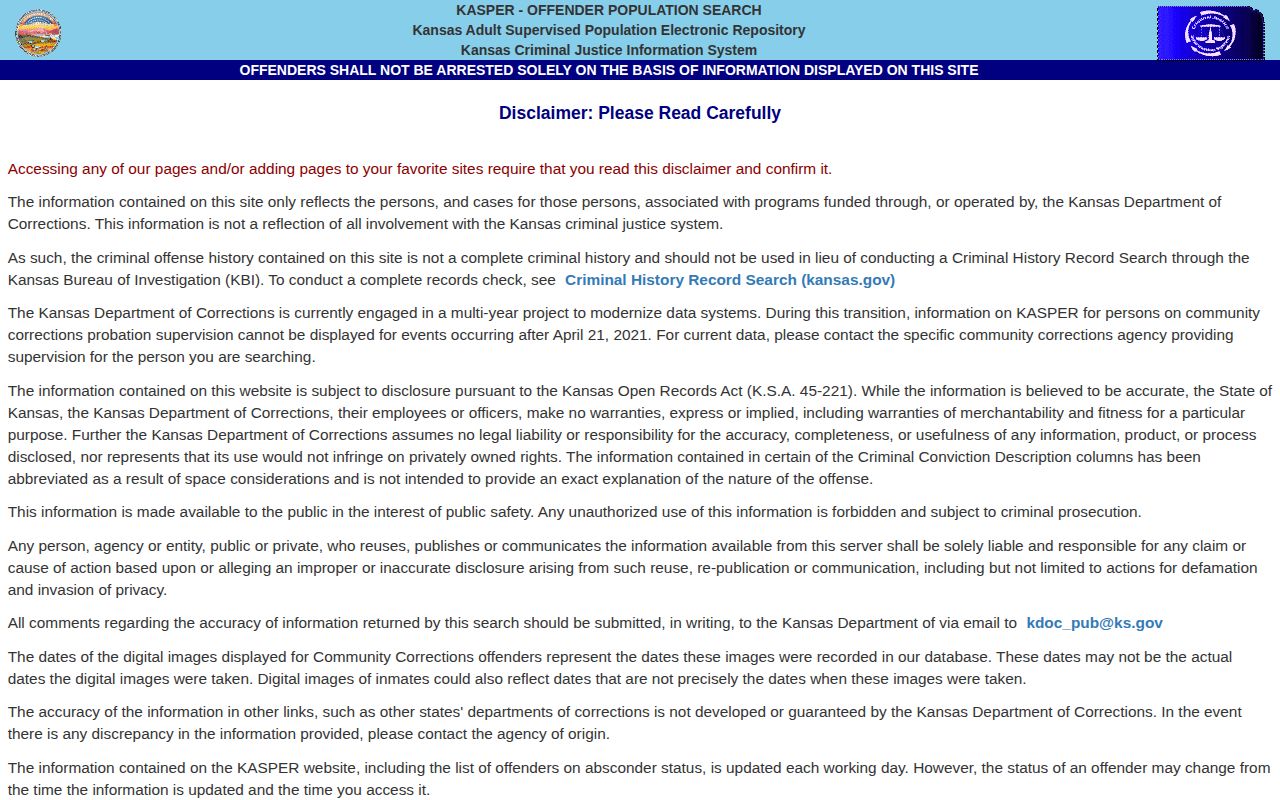
The broad field set helps separate two people with the same or similar names before any status is reported.
Note: Conviction county identifies the case origin, not a person’s home, current location, or planned destination after release.
KDOC Released Inmate Fields
KDOC says a public profile can include the commitment name, registration number, physical description, digital photograph, conviction and case data, current facility, dated movements, anticipated release date, parole office, custody or supervision level, and institutional discipline. Not every record contains every field. Read the set as a whole and keep the official wording.
| Field | How to Read It |
|---|---|
| KDOC registration number | The best direct key for matching and returning to the same record. |
| Name and aliases | Commitment identity and alternate names that help resolve a name search. |
| Conviction county and case | The court origin of the KDOC sentence, not proof of present residence. |
| Custody or supervision level | Shows whether the person is institutional, on a named form of supervision, or discharged. |
| Anticipated release date | KDOC’s changeable computation for a future prison release, not an actual book-out record. |
| Placement and movements | Current placement and dated transfers within the system. |
| Parole office | The office linked to KDOC supervision after physical release, when shown. |
Released is not discharged. Parole, conditional release, and postrelease supervision can mean the person left prison while KDOC authority continues. Discharge marks the sentence endpoint shown by KDOC.
A historic federal court filing preserves a KASPER output with “Current Status: Discharged” and “Date Discharged.” It is useful proof that those labels have existed, but it does not establish that every current profile uses them. No official current documentation promises a universal “Actual Release Date” field.
KDOC Anticipated Release Dates
The official public term is Anticipated release date. It is a live computation, not a guarantee that someone left custody. Good-time and program-credit awards or forfeitures may change it. Court corrections, sentence structure, discipline, parole rules, and a receiving-custodian transfer can also make a future date differ from the eventual release event.
The KDOC field guide for anticipated release dates places that date among the public KASPER information and warns that credit changes can move it.

The label should be copied exactly and checked again after the anticipated day for a status or movement change.
For a deeper explanation of Kansas sentence credits and changing dates, use the Release Date Lookup. It separates state-prison computation from county court and jail records.
Kansas Prison Release and Discharge
Kansas uses two broad sentence systems. Older indeterminate sentences have a minimum and maximum term, parole eligibility, a discretionary suitability decision, and conditional release. Eligibility only permits consideration. A parole grant comes before processing and does not by itself prove that a person has left the prison.
Conditional release is statute-based. Under K.S.A. 22-3718, it follows the maximum term reduced by applicable retained credits and carries written conditions until maximum expiration or another discharge. Sentencing-guidelines cases are generally determinate. Their prison part and mandatory postrelease supervision are computed under law, while the Prisoner Review Board addresses release conditions rather than deciding whether the computed release should occur.
- Parole
- A discretionary release under conditions for an eligible old-law sentence.
- Conditional release
- A statutory release tied to the adjusted maximum term, with conditions still in force.
- Postrelease supervision
- The community-based part that follows the prison portion of many guidelines sentences.
- Discharge
- The end of the state sentence and supervision obligation reflected by KDOC.
Final discharge is governed by K.S.A. 22-3722. It may follow satisfactory performance and ordinarily cannot occur sooner than one year after release unless the sentence expires first. The statute provides a certificate that states restoration of civil rights lost by the commitment. An indeterminate sentence served to its maximum also ends without a further sentence obligation, and PRB describes a maximum-sentence discharge certificate for that endpoint.
Good-time credit also has different effects across these systems. For many guidelines cases, K.S.A. 21-6821 generally caps the prison-portion deduction at 15 percent, while defined lower-severity nondrug and drug categories can qualify for a 20 percent maximum. Conduct, program or work participation, exclusions, and forfeiture still matter. Older pre-July 1, 1993 cases use the separate framework in K.S.A. 22-3725. This is why a single percentage cannot predict every Kansas release.
The Kansas Prisoner Review Board hub explains parole, conditional release, postrelease supervision, and discharge within these two systems.

The Board’s terms help prevent a grant, eligibility date, physical release, and discharge from being treated as the same event.
KDOC Releases Versus County Book-Outs
KDOC operates the state-prison and post-incarceration layer. County sheriffs keep the booking and release records for their own jails. The distinction turns on the custody system, not merely the county named on a conviction. A county can appear in KASPER as the case origin while the person was confined in a state institution elsewhere.
| Question | KDOC state custody | County jail custody |
|---|---|---|
| Who is covered? | People in KDOC custody, qualifying supervision, or discharged from a KDOC sentence | Local detainees and sentenced jail inmates held by a sheriff or host jail |
| Where is release checked? | KASPER status, date, movement, and supervision fields | The responsible county’s booking or release record |
| What can disappearance mean? | Movement, release to supervision, discharge, or a data change | Bond, time served, transfer, court action, or another book-out reason |
| Who supplies documents? | KDOC through its records process | The sheriff or county records custodian |
A movement from a reception unit to another prison is a transfer. It is not a release. The statewide County Directory routes county-only events to the locality that owns the booking or release sheet.
Note: No official statewide source confirms one release exit, transport plan, clothing issue, or fixed cash benefit for all KDOC institutions.
KDOC Release Plans Are Not Releases
The FY2024 KDOC annual report lists 4,072 release plans. That figure must not be called 4,072 completed releases. A plan records preparation work. It does not prove a gate departure, a later supervision status, or final discharge for any named person.
The same report provides separate statewide measures. On June 30, 2024, 6,497 people were under post-incarceration management. Of those, 5,158 were in Kansas, 969 were outside Kansas, and 370 were in abscond status. The report also records 131 parole grants, 140 passes or denials, and 14 continued or other decisions during FY2024. Each number describes a different process.
The managed population also gives a careful trend line. KDOC reported 7,214 people in FY2020, 6,542 in FY2021, 6,426 in FY2022, and 6,638 in FY2023 before the FY2024 count of 6,497. The latest figure was 9.9 percent below FY2020 and 2.1 percent below FY2023, though it remained above FY2022. These are year-end supervision measures. They are not annual release totals, and they cannot establish the status of a named person.
The FY2024 KDOC annual report supports these dated statewide figures. None can confirm an individual release. They show why the record must keep planning, physical release, supervision, and discharge apart.
Request KDOC Release Records
KASPER is a public summary. A narrow records request is the better route when an existing release entry, discharge certificate, maximum-sentence certificate, public sentence record, or movement into supervision is needed. Use the person’s full name, KDOC number, conviction county or case, and a focused date range. Ask for electronic copies and a cost estimate.
The KDOC GovQA portal accepts a new request and lets a requester check its status.
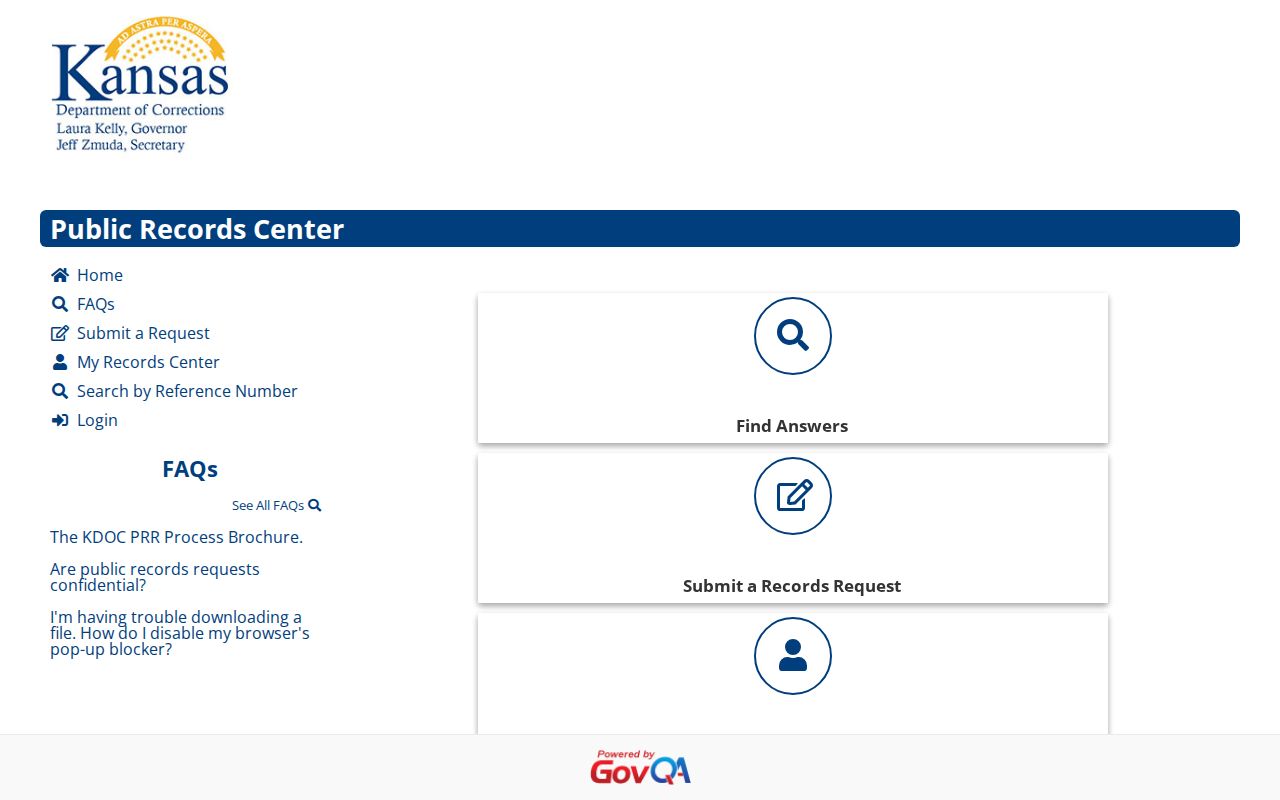
A precise document request gives the custodian a clearer task than asking broad questions about a person’s full history.
The Kansas Open Records Act policy favors access to public records, but it does not open every correctional file. K.S.A. 45-218 calls for action as soon as possible and by the end of the third business day. That is a response deadline, not a promise that production will be complete. K.S.A. 45-219 permits authorized or actual costs and advance payment.
K.S.A. 45-221(a)(29) allows withholding much identifiable correctional material while listing public categories such as identifying information and photograph, sentence data, parole eligibility, custody or supervision level, disciplinary and violation information, most supervision conditions, and facility or parole-office location. KDOC may also withhold protected medical, security, investigation, and supervision-history material while releasing separable public parts.
KDOC’s KORA brochure explains a useful boundary. The agency provides records that already exist, but it does not have to answer questions or build a new report. A request for “all information” can sweep in exempt content and make review harder. A request for a named certificate, dated release entry, or movement record is easier to identify. If some parts are closed, ask for the public portions that can be separated. A delayed response should give the reason and the earliest time the records may be available, while a denial should cite its legal basis in writing when requested.
Ask for a record, not an answer. KDOC need not create a report or respond to a general question when no matching record exists.
When a KDOC Search Fails
A no-result is not proof that someone was never held or is now free. Check spelling, aliases, identifying data, and the working-day update cycle. The event may belong only to a county jail. The person may be an excluded interstate-compact prisoner sent to Kansas. An overturned or expunged conviction or executive clemency may also explain removal.
When the record does appear, preserve a small audit trail. Note the date of access, exact KDOC number, current label, date label, and the fields used to match identity. A later KASPER view can differ because the system has posted a release, transfer, credit change, correction, or discharge. Keeping the original wording makes it possible to describe the change without claiming that an earlier display was a final record. It also helps a custodian locate the right entry if a formal request follows.
If a matching profile exists but the newest event is unclear, compare KASPER with the sentencing court docket and request the narrow KDOC record. A transfer can look like a disappearance from one facility. A future date remains an estimate. A parole grant precedes release processing, and a supervision status can follow physical release for months or years.
The Kansas District Court Public Access Portal can supply the legal context for a sentence, modification, probation order, revocation, or expungement, but a court order does not prove the exact operational departure time. Online document depth also varies with each court’s eCourt conversion. Older converted material may require a courthouse terminal. High-confidence verification therefore pairs the KDOC custody endpoint with the court record that explains why the sentence or release authority changed.
Does “discharged” mean the same as “released”? No. Released can describe leaving prison for parole, conditional release, or postrelease supervision. Discharged marks the endpoint of the state sentence reflected in KASPER.