
Understanding Kansas Inmate Release
A Kansas release is a change in physical custody, not always the end of a case or sentence. A Kansas county jail may book out a person on bond, after time served, because charges were dismissed, under a court order, or into another agency's custody. The last Kansas custody event may be a transfer, even though the name vanishes from the first jail's live roster. Kansas Department of Corrections custody follows a different record path. A Kansas state prisoner may leave an institution on parole, conditional release, or mandatory postrelease supervision while KDOC authority continues. Final discharge is the later endpoint at which the Kansas state obligation shown by KDOC ends.
The official Kansas Department of Corrections home page identifies the agency behind state prison and post-incarceration records.

That Kansas state agency is distinct from the Kansas sheriffs and local custodians who maintain county jail release entries.
| Custody outcome | What it means | Best first record |
|---|---|---|
| Bond or court release | Physical Kansas county-jail custody ends under a court or bond action | Kansas county booking and release sheet |
| Time served | A Kansas jail or prison term reaches its computed endpoint | Kansas release entry plus sentencing court docket |
| Transfer | Custody moves to another Kansas county, KDOC, federal, or immigration authority | Kansas movement or destination field |
| Parole or conditional release | Kansas prison custody ends, but written conditions and state authority remain | Kansas KASPER status and PRB record |
| Postrelease supervision | A Kansas guidelines sentence moves from its prison part to supervised time | Kansas KASPER supervision level |
| Final discharge | The Kansas sentence and supervision obligation reaches its endpoint | Kansas discharge status or certificate |
Kansas Release Record Fields
A useful Kansas release record answers who, when, from where, under what authority, and to what next status. Kansas county records often center on the booking event. KDOC records center on the Kansas sentence, institutional movement, and supervision. Kansas record labels must be copied as shown. An anticipated release date is not an actual book-out time. A Kansas movement date can mark a transfer. Likewise, a Kansas parole office location can show that a person is in the community under supervision, not that the sentence has been discharged.
| Field | What it can establish |
|---|---|
| Full name and aliases | The identity used for the Kansas custody or corrections record |
| Booking or KDOC number | A direct identifier for the Kansas local event or state record |
| Admission and release date or time | The recorded limits of a Kansas county custody event, when maintained |
| Release authority or type | Kansas bond, court order, time served, transfer, parole, or another recorded basis |
| Facility and destination | The Kansas releasing site and a receiving agency when that field is maintained and public |
| Conviction county and case | The Kansas case origin, which may differ from residence or release location |
| Custody or supervision level | Whether Kansas KDOC shows institutional custody, parole, postrelease, or discharge |
| Anticipated release date | Kansas KDOC's current estimate, subject to later computation changes |
| Date discharged | A historically verified Kansas KASPER label for the end of state authority |
The KDOC field guide names anticipated release date, current placement, movements, sentence and case details, parole office, supervision level, physical description, photograph, and discipline among possible public fields.

Not every Kansas release field appears on every person, so an exact live label carries more weight than a presumed interface term.
Request Kansas Release Records
A Kansas local jail record belongs with the sheriff or other county records custodian that held the person. Use the Kansas County Directory to reach that locality, then ask for an existing Kansas booking and release sheet or jail-register entry. A focused request can name the person, booking number if known, date range, and fields sought, such as admission and release time, release type, destination, charges, bond entry, or booking photograph. Kansas local submission methods and charges vary. KDOC does not hold every county booking record.
Kansas state-prison and KDOC supervision documents follow the state route. The KDOC GovQA portal accepts electronic Kansas requests and provides request-status tools.
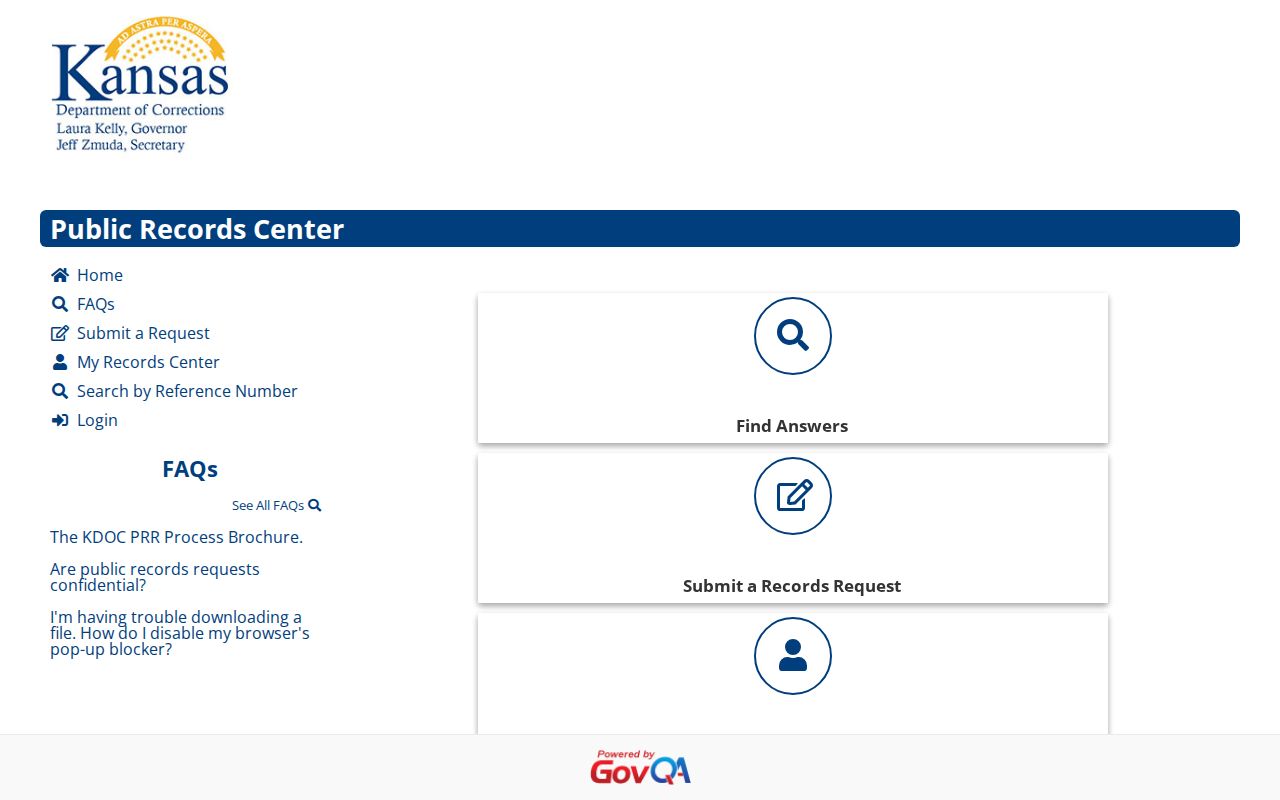
GovQA is the place to seek a narrow existing KDOC release entry, movement record, or discharge certificate, subject to public-record limits.
- Identify the Kansas custodian. Choose the county for a jail event or KDOC for a state sentence and supervision record.
- Ask for a named Kansas record. Supply the full name, booking or KDOC number, case or conviction county, and a useful date range.
- List the Kansas fields or document sought. Request an electronic copy and a cost estimate before work begins.
- Keep the Kansas response and any cited exemption. If production is delayed, note the stated reason and earliest availability.
- Compare the Kansas release record with the court case when the legal reason for release also matters.
Under K.S.A. 45-218, the agency must act as soon as possible and by the end of the third business day. That is a response deadline, not guaranteed production. Kansas law permits authorized or actual costs and advance payment. No one statewide fee applies to every county.
Kansas Releasee Fields Under KORA
The Kansas Open Records Act begins with a policy of openness, but a corrections file is not open in full. K.S.A. 45-221(a)(29) permits some identifiable correctional material to be withheld while listing categories available to a requester other than another inmate or releasee. Those categories include name, photograph and identifying facts, sentence data, parole eligibility, custody or supervision level, discipline, supervision violations, most supervision conditions, and facility or parole-office location.
This field-by-field rule is more precise than calling an entire file public or closed. Security, medical, investigation, and protected supervision material can remain withheld, while separable public portions may still be produced. Kansas law includes a correctional photograph in the listed categories, but it does not promise a statewide online booking-photo gallery. Current official sources also did not establish a Kansas law aimed specifically at commercial pay-to-remove mugshot practices.
Record boundary: Ask for the smallest existing document that proves the release fact, not an unrestricted corrections file or a newly created report.
Kansas Release Plans Aren't Releases
KDOC's FY2024 annual report lists 4,072 Kansas release plans. It does not label that figure completed Kansas releases. A Kansas plan records preparation work and must not be turned into a count of people who passed through a prison gate. The same Kansas report gives separate measures: 131 parole grants during the fiscal year and 6,497 people under post-incarceration management on June 30, 2024. Of that managed group, 5,158 were in Kansas, 969 were outside Kansas, and 370 were in abscond status.
These Kansas measures describe different stages. A Kansas parole grant is a suitability decision, not proof that processing and departure are complete. Post-incarceration management means many people have physically left Kansas prison yet remain under KDOC authority. A named person's Kansas status must come from the individual record, not an annual total.
Kansas County Release Routes Vary
Kansas has no single county-jail release archive. County sheriffs and local custodians maintain their own booking, roster, request, and release practices. The statewide facility review, checked against the KDOC county-jail directory, found no separate operating physical jail row for Cheyenne, Clark, Comanche, Gove, Gray, Sheridan, Stanton, or Wichita counties. Several rely on host facilities elsewhere. A name that leaves a home-county list may therefore reflect transport to Ford, Meade, Scott, Sherman, Thomas, Trego, another county, KDOC, federal custody, or ICE rather than community release.
Start with the county tied to the arrest or case, then read the release destination or receiving-agency field. If another facility took custody, confirm the next record there. Physical host jails should be treated as buildings in their actual localities, while the home county's booking and release record explains its own custody event. This two-county check is especially important when a rural county contracts for jail space.
Note: Leaving one county roster proves only that the first roster no longer shows current custody, not where the person went.
Kansas Discharge Certificate Proof
Leaving a Kansas prison and completing a Kansas sentence are separate milestones. K.S.A. 22-3722 authorizes final discharge after obligations are satisfactorily performed, ordinarily not sooner than one year after release unless the sentence expires first. It also provides for a certificate stating restoration of civil rights lost by operation of the commitment. The Prisoner Review Board says a supervising officer, the Board, or the person may begin an eligible early-discharge request.
A Kansas discharge certificate is stronger proof of the state obligation's endpoint than an old movement showing release to parole or supervision. For a Kansas indeterminate sentence served to its maximum, PRB describes a maximum-sentence discharge certificate. Without early discharge, Kansas supervision continues to the maximum-sentence endpoint. If documentary certainty is needed, request the existing certificate through KDOC and match it to the person's KDOC number and sentencing case.
Find Kansas Released Inmates
Begin with the custody layer, not a broad name search. State prisoners belong in KASPER. County detainees belong with the county that booked or physically held them. Federal sentenced prisoners use the Bureau of Prisons locator. Recent ICE custody uses the immigration locator. The court docket then explains the legal action behind release, while the custody record establishes the operational change. These sources are related, but none replaces all the others.
The KASPER entry page explains that information is updated each working day and is not a complete criminal history.
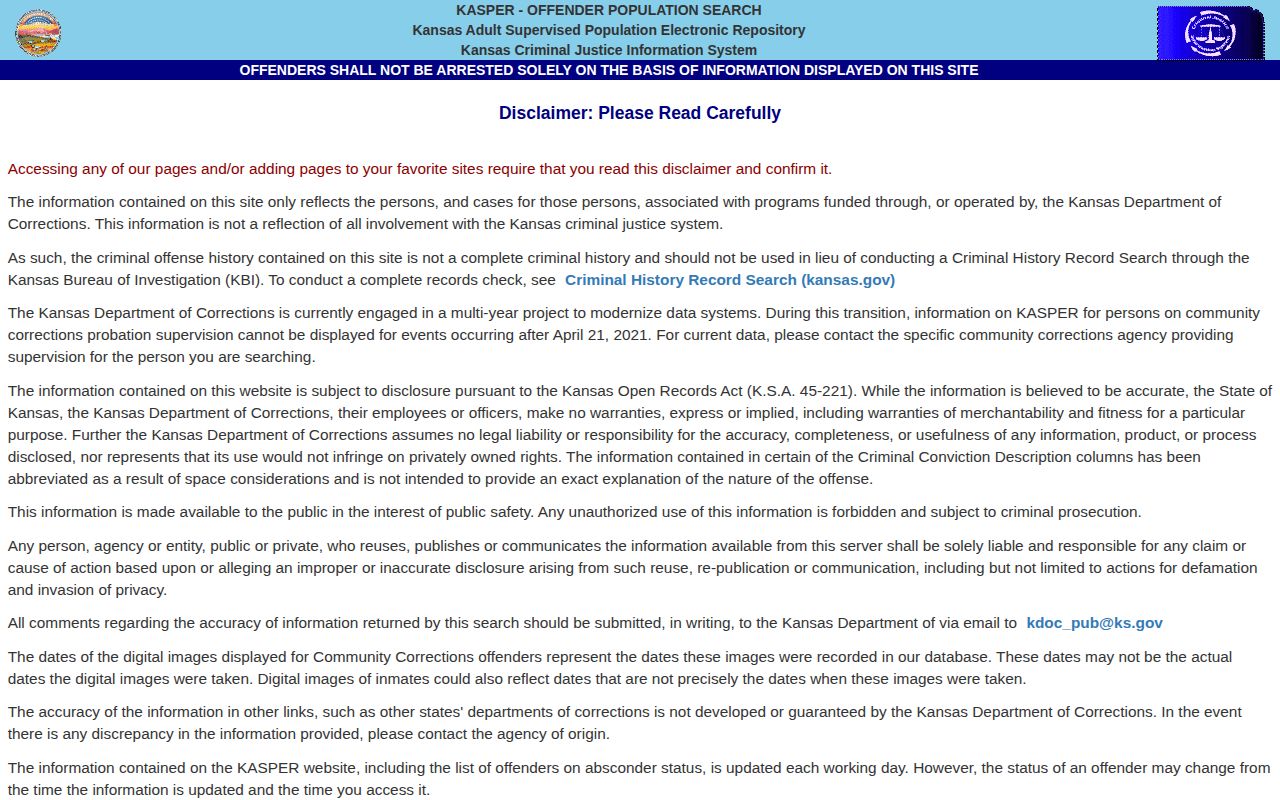
The warning matters after a weekend release, return, transfer, correction, or other change that can reach the public view later.
- Confirm the person's full name and strongest known Kansas identifier, such as a KDOC, booking, BOP, or A-number.
- Identify the last known Kansas custodian. Do not use a county live roster as the sole search for someone already released.
- Search KASPER for Kansas custody, or contact the correct county custodian for its booking and release record.
- Read each Kansas status and date label exactly. Separate release, transfer, supervision, anticipated release, and final discharge.
- Check the Kansas court case for the order or disposition and use federal or ICE tools only when that custody layer applies.
- Request the underlying Kansas record when an online result is missing, stale, or too thin to prove the event.
Important: A released person normally drops off a live jail roster, so absence alone does not prove release, transfer, or present freedom.
KDOC Search for Kansas Releases
KASPER stands for Kansas Adult Supervised Population Electronic Repository. It includes people sentenced to the Secretary's custody since 1980 who are incarcerated, under post-incarceration supervision, or discharged. It does not aggregate all county-jail bookings. Interstate-compact prisoners sent to Kansas are excluded, and names normally remain unless a conviction is overturned, expunged, or executive clemency is granted. The deeper KDOC Offender Search explains this state-prison route in detail.
The live KASPER application supports direct identifiers, names, aliases, and advanced fields.
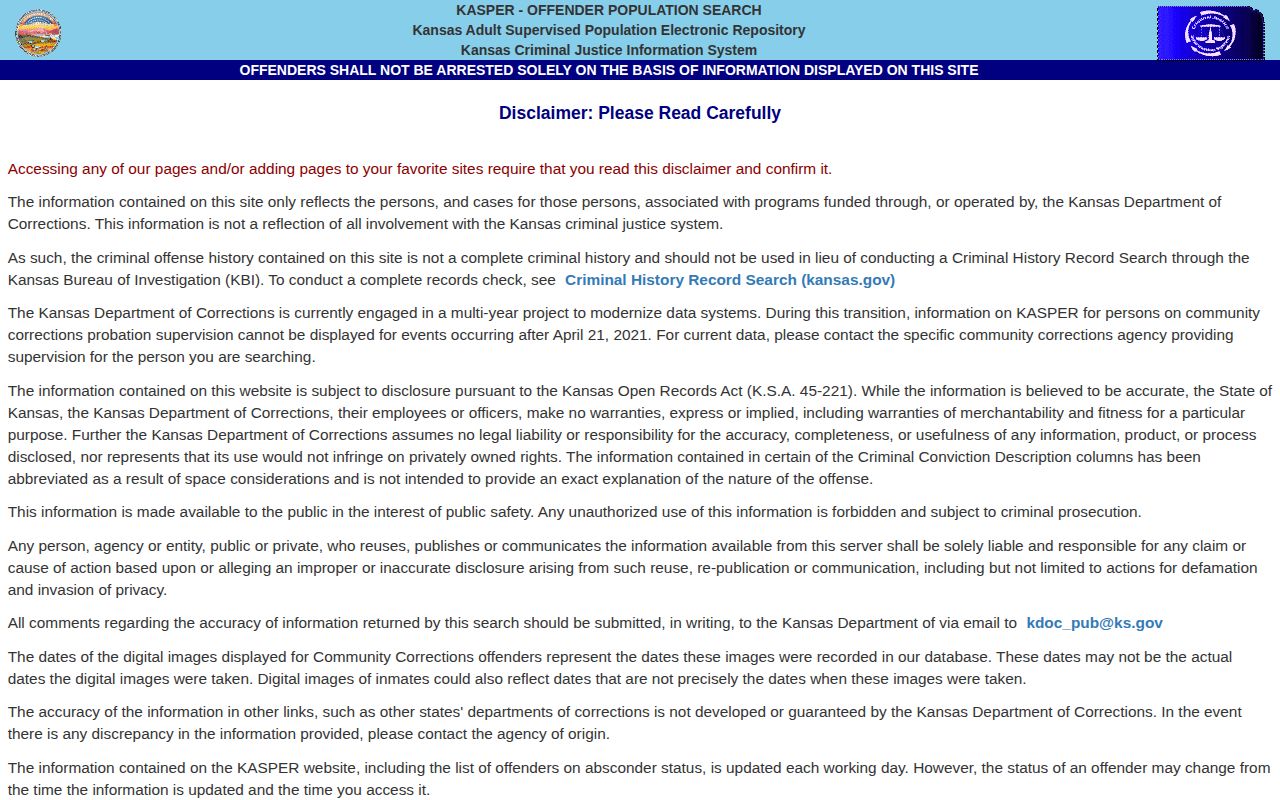
A KDOC number is the strongest starting value, while advanced fields help separate people with the same name.
| Search or match field | How to use it |
|---|---|
| KDOC number | Use for the most direct Kansas state record match |
| First, middle, last name | Try the recorded Kansas form and compare aliases |
| State ID or KBI number | Narrow a known Kansas identity |
| Birth date or age range | Separate common Kansas names without relying on one trait |
| Race and gender | Use only as supporting Kansas identity checks |
| Conviction county | Match Kansas case origin, not presumed residence |
| Parole-supervision county | Narrow a known Kansas supervision area |
Open the detail and compare the name, aliases, photograph, description, conviction county, case, and offenses. Then read status, custody or supervision level, sentence dates, movements, and parole-office location together. A no-result can reflect spelling, an excluded compact case, a county-only event, expungement, an overturned conviction, or clemency. It cannot support a claim that no custody event occurred.
Kansas Release Decisions Need Context
Older Kansas indeterminate sentences use minimum and maximum terms, parole eligibility, and a discretionary suitability decision. Kansas guidelines sentences are generally determinate, with a computed prison part followed by mandatory postrelease supervision. The Kansas Prisoner Review Board uses the outcome terms parole, continue, and pass. A Kansas parole grant still comes before release processing. A continue holds the matter for more work or deliberation. A pass denies Kansas parole for a stated period.
The PRB public-comment calendar is a rolling monthly schedule, not a fixed annual archive or a final-results search.

Its prospective list can show a comment month, later hearing month, and possible eligibility month, but none proves that a person left custody.
Kansas Release Portals Have Gaps
KASPER retains discharged KDOC cases, yet its disclaimer says community-corrections probation events after April 21, 2021 cannot be displayed during system modernization. District-court probation and community corrections are also distinct from KDOC parole and postrelease supervision. A missing recent probation event in KASPER does not prove that supervision ended. The sentencing order, current local agency, and court clerk remain key checks.
The Kansas District Court Public Access Portal searches statewide case information and requires registration for Smart Search. Filters can include county, name, date of birth, KBI number, sheriff-office number, booking number, case type, case status, filing dates, and judicial officer. Online document depth begins with each court's eCourt conversion. Some older converted material may be available only at a courthouse terminal, while sealed, expunged, juvenile, and other protected matters do not appear publicly.
Note: A thin online result should lead to the responsible clerk or agency, not to a claim that the record or supervision does not exist.
Kansas Release and Disposition Differ
K.S.A. 22-4705 treats release after arrest without charges, court disposition, commitment, release from detention, escape, pardon or commutation, later sentence changes, and expungement as separate reportable events. That split explains why one source rarely tells the whole story. The jail or KASPER record can establish the custody endpoint. The court docket supplies the legal reason, such as bond, dismissal, judgment, jail credit, probation, revocation, or commitment.
A Kansas court order authorizing release does not establish the actual book-out time or show whether another hold took effect. In the same way, a Kansas county roster disappearance does not reveal whether the case was dismissed. High-confidence Kansas verification pairs the operational custody record with the legal disposition, using matching names, identifiers, case numbers, and dates.
Other Kansas Release Channels
Kansas VINE covers people held in county jails, not KDOC state-prison residents. Search a specific person in Kansas VINELink, verify the source agency and identity, and use an offered notification method for an active record. KDOC Victim Services operates a separate notification route for state-prison and KDOC-supervised cases. Release, transfer, and escape are distinct events, so the alert wording should be read exactly.
The Kansas VINELink portal is the statewide entry for a county-jail custody check and notification registration.
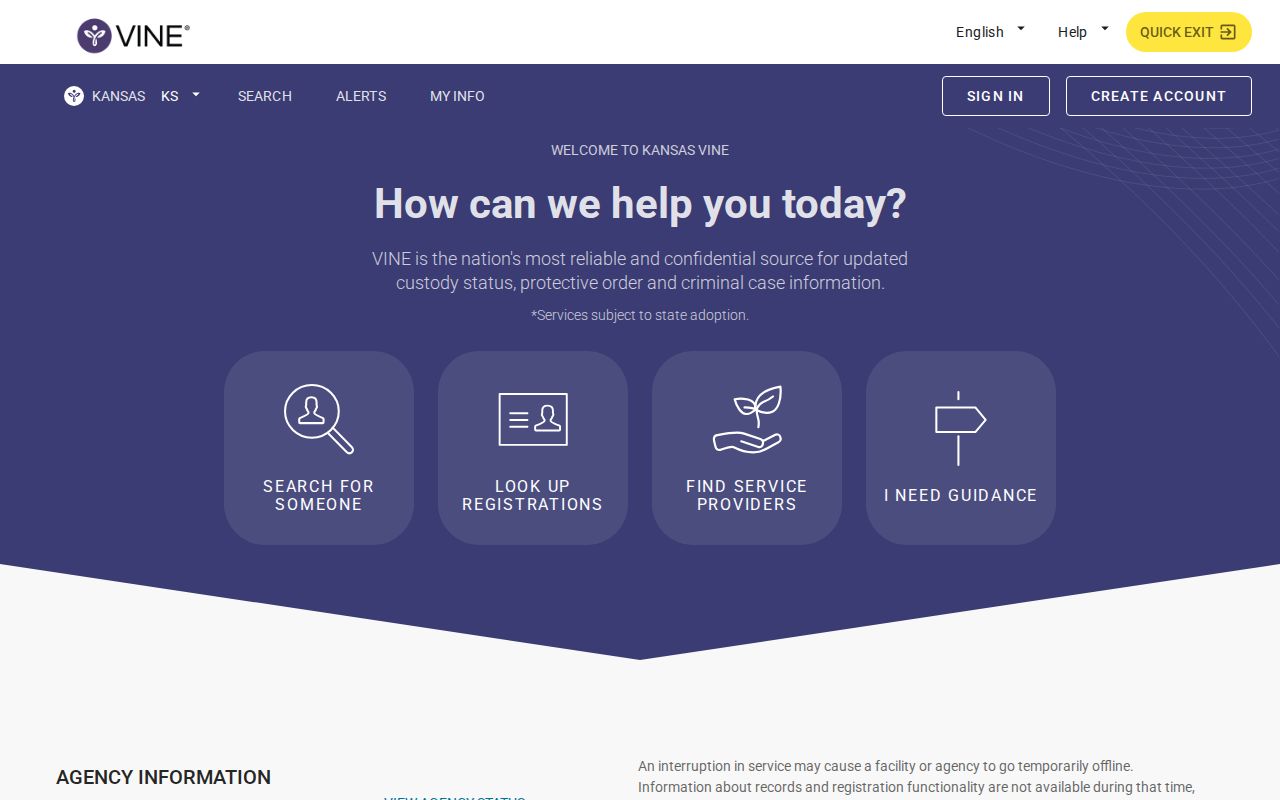
Its live agency and custody labels are the best evidence for a specific participating record, since county feeds need not update in the same way.
Kansas Federal Release Records
Federal sentenced custody uses the BOP Inmate Locator, which covers federal records from 1982 forward.
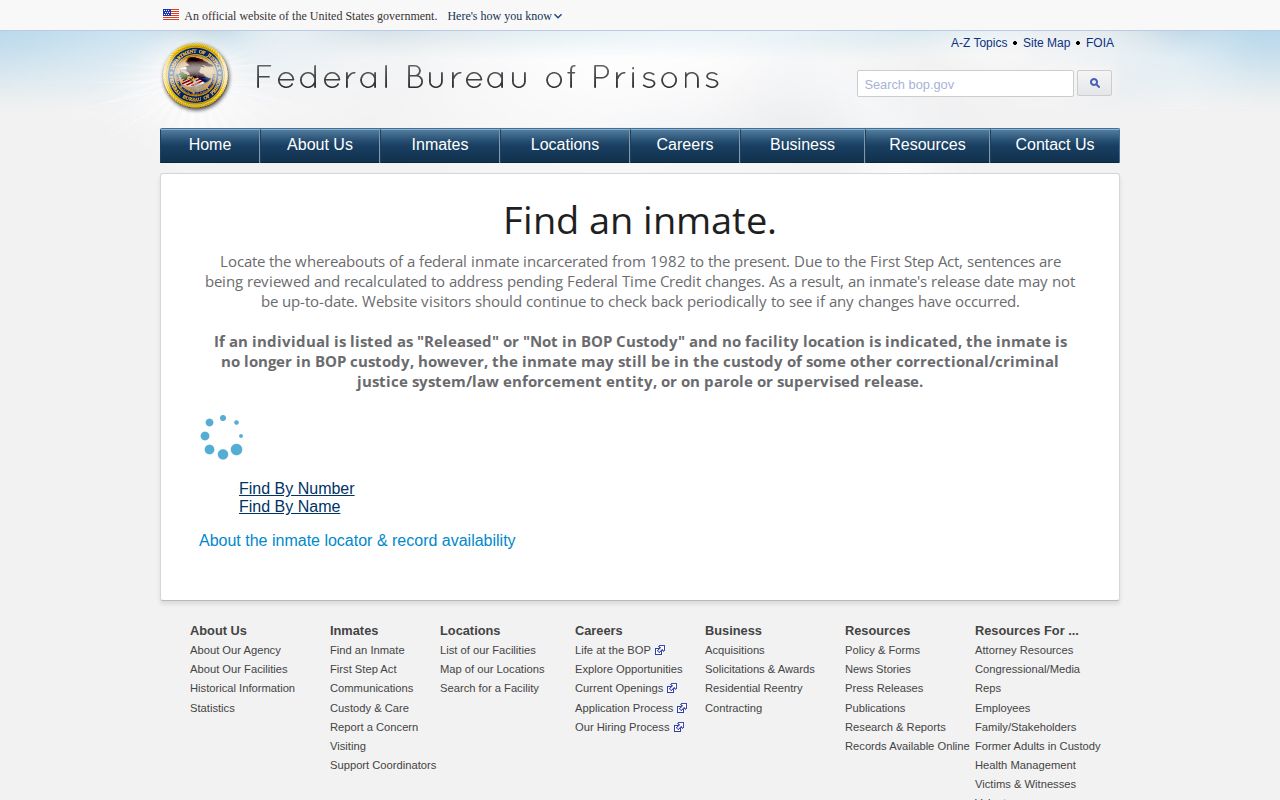
A past release date with location shown as RELEASED means the person is no longer in BOP custody, but it does not rule out supervision or custody by another agency.
The ICE Online Detainee Locator covers current immigration detention and people released from ICE custody within the last 60 days. It is not a durable Kansas release archive. Search by a nine-digit A-number and country of birth when possible, or use exact biographical details. A no-result can reflect the time window, spelling, a different custody system, or a record outside the locator's scope.
Compare Kansas Release Sources
Each source answers a narrow question. A current jail roster is best for present local custody. A county release record documents a completed local book-out or transfer. KASPER follows the KDOC population through incarceration, post-incarceration supervision, and discharge. BOP and ICE cover their own federal systems. Court records explain legal action but are not operational custody locators.
- Kansas county jail roster
- Use it for current Kansas local custody. Released people often disappear from the live list.
- Kansas county release record
- Use it for local release time, type, authority, or destination when kept. Coverage stops at that Kansas county.
- Kansas KASPER
- Use it for KDOC custody, supervision, movements, dates, and discharge. It is not a Kansas county-jail booking archive.
- Kansas court portal
- Use it for Kansas bond, orders, sentence, disposition, and probation context. It does not prove operational book-out.
- Kansas VINE
- Use it for specific Kansas county-jail custody checks and alerts. It does not cover KDOC residents.
- BOP and ICE locators
- Use each for its own federal custody layer. Neither replaces Kansas county or KDOC records.
Is a future date proof of release? No. KDOC calls its public field an anticipated release date, and BOP future dates are also projections. Credits, discipline, sentence changes, detainers, transfers, or recalculation can change the date. Confirm release through the later custody status and underlying record.
Does “discharged” mean the same as “released”? No. Release can mean physical departure into parole or postrelease supervision. Discharge marks the endpoint of the state sentence or supervision reflected in KDOC records.