
Kansas Supervision Status Differences
A person can be out of a Kansas prison yet remain under correctional authority. Parole is a discretionary release route used chiefly for an older indeterminate sentence. Postrelease supervision generally follows the prison part of a determinate sentencing-guidelines case. Probation is ordered by a district court instead of being a release from prison. Community corrections may administer an intensive form of probation, while Court Services handles other probation cases. These labels matter because KASPER, the courts, and local programs do not hold the same facts.
The Kansas Prisoner Review Board, or PRB, makes parole suitability decisions in the cases within its authority and sets or addresses release conditions. KDOC Parole Services supervises people on parole and postrelease supervision. District courts remain the starting source for probation. A current court order should identify Court Services or the community-corrections program responsible for the case.
| Status | How it begins | Primary verification source |
|---|---|---|
| Parole | PRB grants conditional release in an eligible indeterminate case | KASPER status, parole office, and PRB records |
| Postrelease supervision | Follows the prison portion of an applicable determinate sentence | KASPER and KDOC Parole Services |
| Probation | A Kansas district court orders community supervision | Court docket, sentencing order, and Court Services |
| Community corrections | A court assigns an eligible probation case to a local program | Court record and the named local program |
| Discharge | The sentence expires or eligible early discharge is approved | KASPER plus a discharge certificate or order |
- Absconder
- A person alleged to have stopped reporting or left supervision without authorization. It is not the same as a new conviction.
- Discharge
- The endpoint of the sentence or supervision obligation, not merely the day a person leaves prison.
- Compact supervision
- Supervision administered across state lines under an interstate arrangement.
Check Kansas Post-Release Supervision
KASPER, the Kansas Adult Supervised Population Electronic Repository, is the best first public check for KDOC parole or postrelease supervision. Its population includes people incarcerated, under post-incarceration supervision, or discharged after a Kansas sentence. It is not a complete criminal history and does not collect every county-jail release. The repository updates each working day, so a new release, return, or corrected status may not appear at once.
The KASPER application shows the search fields used to identify a record.
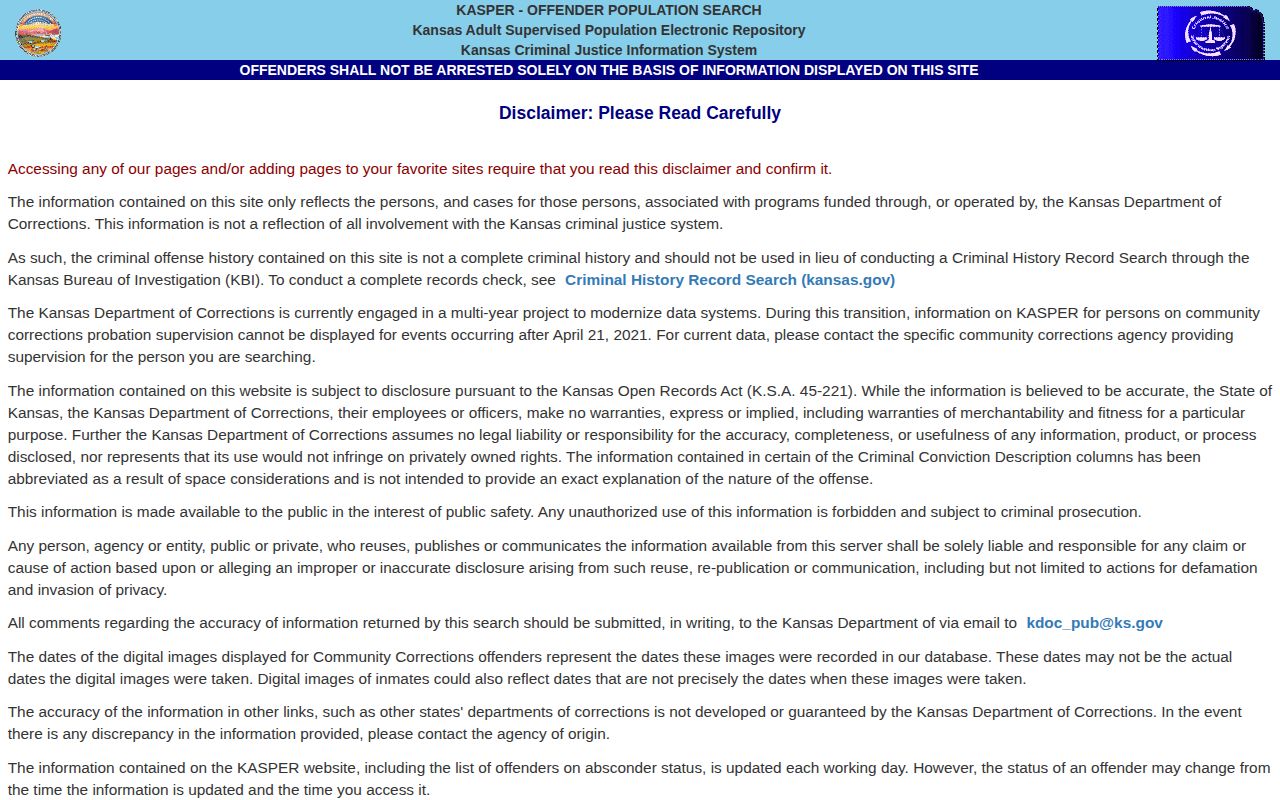
Use the KDOC number when known, then compare aliases, birth details, conviction county, photograph, offenses, and case number before relying on a match.
- Read and accept the KASPER disclaimer, then search by KDOC number or by name.
- Narrow a common name with birth date, KBI number, conviction county, or parole-supervision county.
- Open the detail and read current status, custody or supervision level, movements, and parole-office location together.
- For probation, open the Kansas district-court case and read the current order instead of treating a KASPER absence as discharge.
- Contact the listed office or local program when a current operational status needs confirmation.
For a broader custody-to-release search, the Kansas released inmates hub separates KDOC, county-jail, court, federal, and immigration records.
Kansas Parole Office Routing
KASPER may name a parole office, but the public office directory is the source for its current contact route. Conviction county is not a safe substitute for the supervising office. A person may live in another Kansas region or be supervised outside Kansas. The directory is also not a public list of individual caseloads. Match the person through KASPER first, then use the office entry tied to that record.
The official KDOC parole office directory organizes supervision contacts across the state.
This statewide directory avoids presenting one office as the contact for every Kansas release.
KDOC Parole Services
Use for: Current regional office routing for parole and postrelease supervision.
Person lookup: Search KASPER first and note the displayed parole-office location.
View parole office contacts
Conditions are case-specific. KASPER can show the supervision level and certain public information, while the governing order or supervision record controls. A reported violation can lead to review, a warrant, a return, or a revocation process, but a public status should be copied with its date and exact label.
Compact supervision needs the same care. KASPER may identify a Kansas sentence and compact status even when day-to-day supervision occurs outside the state. Conversely, conviction county does not reveal the office now responsible. Use the current repository label and office route, then ask that agency to confirm its own record. Do not infer the place of supervision from the prison that released the person or the county that entered the judgment.
Note: A parole-office location identifies an administrative route; it does not establish a home address or a current appointment schedule.
Kansas Supervision Absconder Searches
Kansas maintains two public absconder paths, and they answer different questions. One covers parole supervision. The other covers community corrections. Combining them would hide the agency distinction and could cause a probation record to be described as parole. Both lists can lag because the KASPER disclaimer says updates occur each working day. The state also warns against making an arrest based only on the display.
The official Kansas parole absconder search is the parole-specific path.
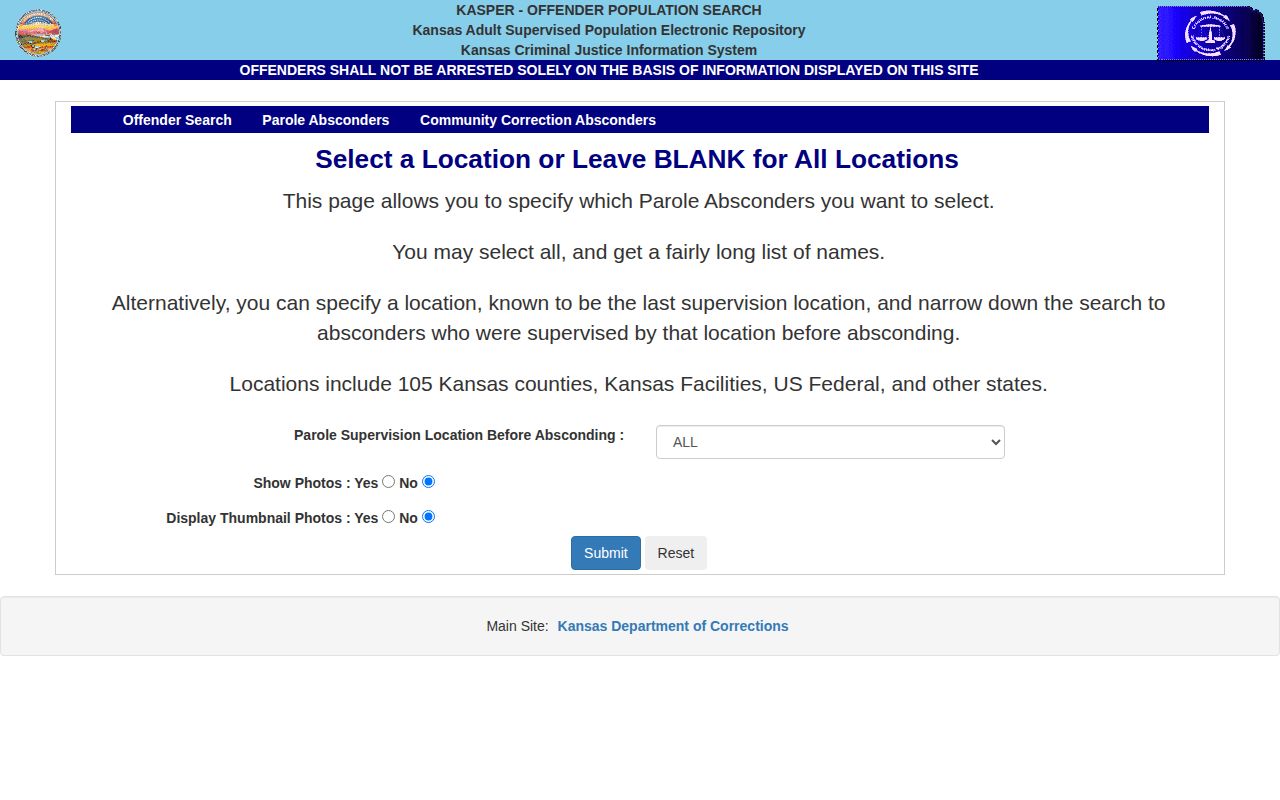
Confirm the identity and the date of the result, then pass current information to law enforcement or the official KDOC enforcement route.
The separate community-corrections absconder search covers that probation channel.
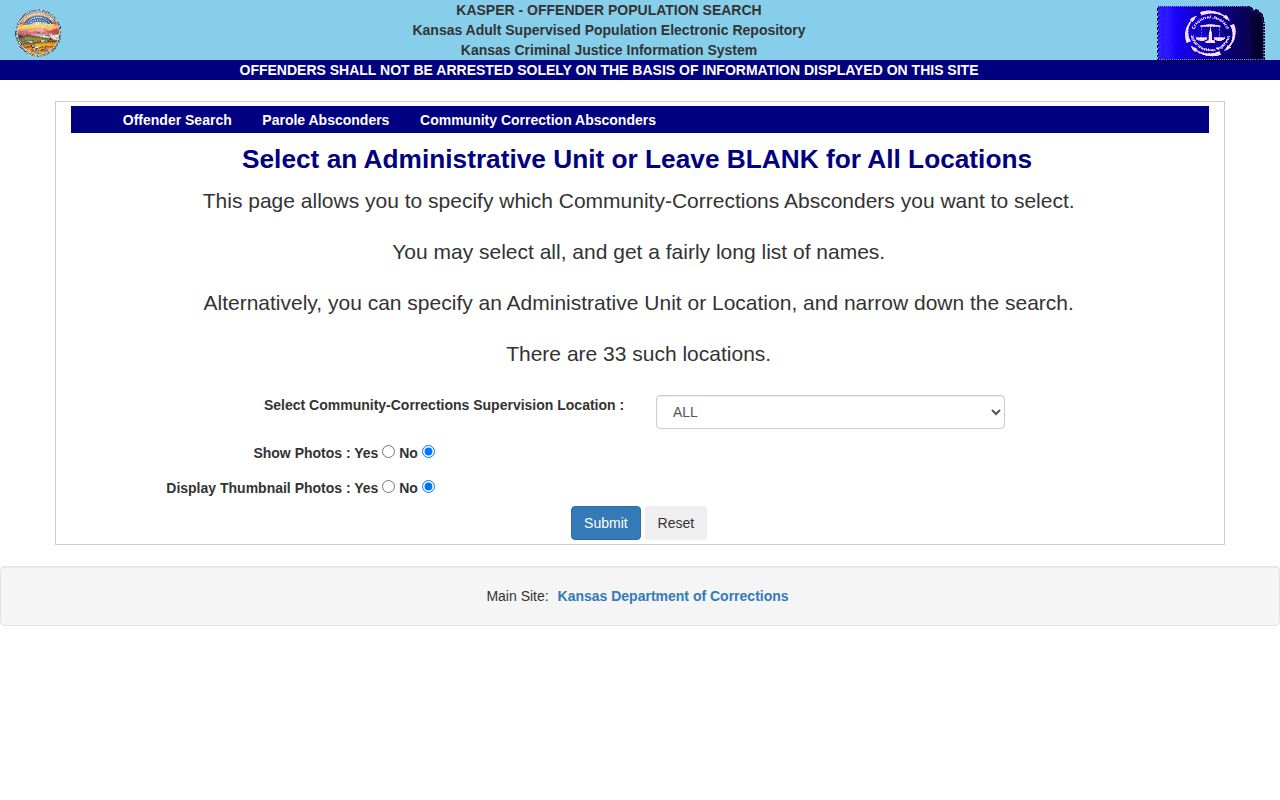
A result in one list should not be restated as a result in the other. Do not confront the person or turn an old listing into a current allegation.
Kansas Release Plans Start Early
KDOC reported that 82 percent of residents in FY2024 had a release plan that met its listed case-management elements. That statistic measures plans meeting those elements, not a guarantee that each need was met and not a count of completed releases. The framework covers basic immediate needs, pro-social support, and a schedule for the first 24 hours, first week, and first month after prison.
The timeline helps explain why supervision records may identify an office soon after a prison movement changes to community status. It is a statewide case-management structure. The record still must be checked for the named person, and a plan is not proof that a gate release occurred on the anticipated date. KDOC separately reported 4,072 release plans, which must not be relabeled as completed releases.
The Kansas Prisoner Review Board hub explains parole, postrelease conditions, discharge, and revocation roles.

The Board framework links release decisions and conditions to supervision, while KDOC Parole Services handles field supervision.
The size of the system also puts the plan data in context. On June 30, 2024, KDOC reported 6,497 people under post-incarceration management. Of those, 5,158 were in Kansas, 969 were outside Kansas, and 370 were in abscond status. The total was 9.9 percent below FY2020 and 2.1 percent below FY2023, though it was higher than FY2022. These figures describe a dated statewide population, not the live status of any named person.
Physical release often begins the supervision phase. It does not close the record. A KASPER entry may move from an institution to parole, conditional release, postrelease supervision, or compact supervision. Each label means the person has left prison under a continuing form of authority. The office location and current status should be read with the movement date, because an old office entry or historic release movement cannot settle today's status on its own.
Kansas Probation Portal Gaps
KASPER preserves many discharged KDOC cases, but it is not complete for modern community-corrections probation. Its disclaimer says community-corrections events after April 21, 2021 cannot be displayed during system modernization. A no-result therefore does not prove probation never began or has ended. The Kansas District Court Public Access Portal should be checked for the sentencing and later supervision orders.
Court access has a second limit. Statewide Smart Search can locate case information, yet online document depth begins with each district court's conversion to the eCourt system. Older converted documents may require a courthouse terminal. Sealed, expunged, juvenile, and other protected records are not available through ordinary public access. When the online trail is thin, contact the responsible district-court clerk, Court Services office, or community-corrections program identified in the case.
Smart Search requires registration, a name or case number, and reCAPTCHA. Advanced filters can include county, date of birth, KBI number, sheriff-office number, booking number, case type, case status, filing dates, and judicial officer. Those filters help separate common names. The docket can explain an order of probation, a violation, revocation, or later disposition, but it is not a live supervision locator. Verification still ends with the agency named in the most recent order.
Note: A thin KASPER or court result is a routing signal, not proof that Kansas supervision has ended.
Kansas Discharge Certificate Proof
Final discharge is stronger proof of the sentence endpoint than an old movement entry showing release to supervision. Under K.S.A. 22-3722, final discharge may follow satisfactory performance of obligations and ordinarily cannot occur sooner than one year after release unless the sentence expires first. The certificate states the restoration of civil rights lost by operation of the commitment.
PRB says a supervising parole officer, the Board, or the person may begin a satisfactory-adjustment discharge request. Certain 12-, 24-, or 36-month postrelease terms may permit a petition after restitution is paid. Without early discharge, supervision continues to the maximum-sentence endpoint. For an indeterminate sentence served to its maximum, PRB describes a maximum-sentence discharge certificate.
When documentary certainty matters, ask KDOC through GovQA for an existing, narrowly named record, such as the discharge certificate, maximum-sentence certificate, or release-to-supervision movement. Include the full name, KDOC number, conviction county, case information, and date range. Request electronic copies and a cost estimate. KDOC may withhold protected material while releasing segregable public portions.
The Kansas Open Records Act does not make the whole correctional file public. K.S.A. 45-221(a)(29) identifies categories that may be disclosed, including sentence data, parole eligibility, custody or supervision level, violations, most supervision conditions, and the supervising parole-office location. Other identifiable correctional material may remain closed. A focused request is more likely to reach the precise endpoint record than a demand for every supervision file.